Table of Contents
Report

Author(s):
Eughan Davies
Bartosz Kuron
Carina Bentin
Anthony Fountain
Paloma Fernández De Toro Ronda
Kristjan Suits
Acknowledgement
In this part we want to thank the organizers of the whole European Project Semester. Firstly and the biggest thank you is for Abel Duarte and Pedro Barbosa Guedes who always point us in the right direction with advices, tips and answers or solutions on many questions and problems we had. Everyone was very friendly, helpfully and with no stress. Next of course thanks to all clients who listen to our project process in the meeting every week. Sometimes with good ideas and good discussions. Thank you Maria Benedita Malheiro for conducting the whole process by having everything under control and giving us the right advises to satisfy the deadlines. Last but not least thanks to all teachers of each class for the motivation although we all were a bit tired with no vigor sometimes.
Abstract
It is estimated that by the year 2050 the Earth population will increase to 9.6 billion thus the world hunger is expected to grow even further.
This paper deals with one of the possible solutions to eradicate hunger in the world, through engaging people in a more sustainable feeding process.
As the population of the human race is ever-growing, the current use of our planets resources is not sustainable. Global hunger issue is a grave problem and will grow even further within the next years. Recurrent and easily manageable sources of food are a necessity.
The project approaches this with an automatic system to breed several different insects in a flexible environment. The positive aspects of the Insectarium are the quality material used such as PMMA (Polymethyl Methacrylate) which provides the enclosure with superb insulation. The system also uses low powered devices such as Arduino which controls the Insectarium and reduces maintenance and costs.
Our product was born as an innovative and sustainable idea using reusable and quality materials. The design and the components give people a chance to win a war with hunger in the present and the future, what makes our product desirable and forward-looking.
Glossary
| Abbreviation | Description |
|---|---|
| AC | Alternating current |
| AIDA | Attention, Interest, Desire, Action |
| B2B | Business to Business |
| CMR | Customer Relationship Management |
| DC | Direct current |
| DESTEP | demographic, ecologic, social, technological, economic, politic few of environment |
| DHPE | High-Density Polyethylene |
| EPS | European Project Semester |
| ESP | Emotional Selling Proposition |
| EU | European Union |
| ISEP | Instituto Superior de Engenharia do Porto |
| LCA | Life Cycle Assessment |
| LCD | Liquid Cristal Display |
| LOHAS | Lifestyle Of Health And Sustainability |
| PP | PolyPropylene |
| PVC | Polyvinyl Chloride |
| PP | PolyPropylene |
| PLC | Programmable Logic Controller |
| PMMA | Polymethyl Methacrylate |
| PVC | Polyvinyl Chloride |
| SAP | Software, Anwendungen, Produkte in der Datenverarbeitung |
| SWOT | Strengths, Weaknesses, Opportunities, Threats |
| TVVS | Technischer Vertrieb und Verkaufs Strategien (technical distribution and selling strategies) |
| UHMW-PE | Ultra High Molecular-Weight Polyethylene |
| USB | Universal Serial Bus |
| USP | Unique Selling Proposition |
| 3D | Three-Dimensional |
1. Introduction
As the population of our planet is growing, in the future need for new sources of nutrition will grow even more – an innovative way to grow food is necessary. Our team aims to provide every household a possibility to grow their own cheap recurrent food in a really unconventional way. Growing insects is green, simple and does not take much room nor time. It’s a great source of proteins which you need for your body to function properly. The electronic devices which change temperature, lighting, aeration are really easy to use and they consume very little energy. The shelter for insects by Insecto is the perfect place to grow your future food, either for your fishing activities, pet food or why not yourself.
1.1 Presentation
We have got a great pleasure to introduce to you our team. We are a group of young, creative but most of all hardworking people that are going to work together with devotion for the next few months. Our team consist of 6 people, each of us is a specialist in different field and from different country and thanks to this diversity we can provide creative and solid solutions. Our team members:
- Carina Bentin - Germany - International Marketing and Purchasing in Engineering
- Anthony Fountain - Belgium - graphic design and digital media
- Paloma Fernández De Toro - Spain - Building Engineering
- Bartosz Kuron - Poland - Computer Science
- Eughan Davies - Scotland - Electrical/electronic engineering
- Kristjan Suits - Estonia - Environmental Engineering

Figure 1.1: Example of an insectarium in New Orleans
1.2 Motivation
Our team agreed that European Project Semester is a great source of knowledge and helps to develop many important skills. All of us believe that it is a great opportunity to work in a group and meet other culture. It is also a chance to make interesting project and improve language. We hope that our project will be a source of knowledge to both laymen and professionals. However, motivation is also a personal thing.
Bartosz Kuron: “I've chosen EPS because I would like to take part in international, multicultural project where I can improve my teams skills and find my strongest and weakest sides. I would like also bring something new to the market and impove my languages skills. I have chosen the Insectarium as a project because it seems possible to apply my features on it.”
Anthony Fountain: “EPS is a chance to gain experience abroad, learning other languages, meeting new people and being independent. One of the main reasons is to move my own boundaries to improve my confidence an projectskills. i have chosen the insectarium because of it's unique innovative approach of food-ware. Something new , something interesting which makes me curious and motivated. I also watched several documentaries about the meat industry of today which is destroying planet's earth because of the resources needed to produce meat. So we need a change !”
Kristjan Suits: “I choose EPS because I was thinking that this could be something really different and maybe get some kind of new skills to apply in my field of study. Aswell improve my spoken language.As for the project, Insectarium was chosen as it seemed to adress a serious issue in the world which can't be overlooked, doing that gives you a sence of mission.”
Paloma Fernández De Toro: “I've chosen EPS because I want to do a different project than the one that I would have done in my university and I want to put my knowledge in a different project, even if it is with insects. I choose the insectarium because is one of the project's proposals that would make me think more about how to build it, something more related with materials and things that I have studied.”
Carina Bentin: “ I choose EPS as an alternative to my bachelor-thesis. I like to get to know new people, know the city, enjoy the new experiences and improve my english for my future in the company. Furthermore I decided for the Insectarium because it was imaginable and i had a little idea how it could look like. And another point is of course, that the project makes sense, which is usable in the future and we have the chance to finish it completely with our knowledge. ”
Eughan Davies “I´ve chosen the EPS to get to know new people, to see Porto and to work with and for a team. I think I can use my skills to bring the project forward. I like to work on devices with electronical parts, and that was possible with the Insectarium.”
1.3 Problem
The Insectarium looks at solving the issues of how to produce food to feed the world's population in the future, Recent figures imply that there are more than 200 million insects for each human on the planet,the challenge of our project is to build an enclosure with the appropriate conditions to grow Meal worms. The Insectarium should be low cost, effective and have a dynamic and functional design.
1.4 Objectives
Design and construct an insectarium with the appropriate conditions to grow insects.The insectarium must be inexpensive, productive and have an elegant and functional design.Our team must stick to a strict budget of 100€ and must complete the project within a limited time scale of 4 months. The Project requirements are the Insectarium must :
• Look Elegant for the Market
• Have an efficient and functional enclosure which is built with the correct conditions to grow insects such as Mealworms
• Use low cost hardware solutions such as Arduino software for the programming of our control devices.
• Have exceptional control devices which are effective in monitoring and controlling Insects such as sensors.
• Be economical and well designed.
• Be as sustainable as possible.
• Use software such as open source and freeware to reduce costs.
• Comply with the following EU Directives:
• Machine Directive (2006/42/CE 2006-05-17);
• Electrical Safety: Low Level Voltage Directive (2006/95/CE 2006-12-12);
• Restriction of Hazardous Substances (ROHS) in Electrical and Electronic Equipment Directive (2002/95/EC 2003-01-27);
• Mandatory adoption and use of the International System of Units (The NIST International Guide for the use of the International System of Units).
1.6 Use Cases
The Client wants :
• A functional and elegant design - we aim to meet this by designing an Insectarium with a name,logo and instruction manual which will be tested to ensure it meets the demands.
• Use of Low cost hardware solutions - we look to meet this by using Arduino software for programming Electrical devices such as sensors and automatic feeders which will be designed and tested.
• An insectarium with appropriate conditions - we intend to do this by having plants and Sand and ensuring the Mealworms are in the correct temperature and humidity to make the insects feel comfortable which will be tested.
• A sustainable Insectarium - We aim to do this by ensuring our Electrical devices such as Sensors,Automatic feeders,motors and Timers use low power and by making the enclosure efficient and appropriate for the environment the insects live to reduce the use of these instruments as much as possible, this be tested to check the daily power usage of the insectarium.
• Something extra which we aim to execute by having a timer and an automatic feeder circuit which feeds the insects at a particular time of the day to ensure they are looked after,this will be tested .
We aim to have different sections to allow the insectarium to automatically remove the Insect defecation by using a motor to turn a net and having a sophisticated layer of woods,nets to ensure all the insect defecation is successfully removed to allow the insectarium to be reasonable clean automatically,this will also be tested.
1.7 Functional Tests
Devices
Humidity and temperature sensor - This device will be tested on breadboard before soldering onto a circuit board once we know it is working and ready.
LCD - Used to display the temperature and humidity - this display will also be tested on breadboard.
cooling fan - This device is part of the Temperature control system we are using and will be tested to ensure it activates when the temperature in the Insectarium is too high.
Electric Heater - This device is also part of the temperature control system and will be tested to ensure it activates to increase the temperature if the insectarium is too low.
Arduino UNO - Arduino Uno is what we are using to programme the temperature control system ,this will be designed and tested in the university workshop .
1.8 Project Planning
Gantt Chart
We made a ganttchart for 5 reasons :
• Avoid Completion Confusion
• Keep Everyone on the Same Page
• Understand Task Relationships
• Effectively Allocate Resources
• Get a realistic view on the Future

Figure 1.2: Gantt Chart of our team
1.9 Report Structure
Table 1.1: Structure of our reports of our project
| Task | Description |
|---|---|
| Introduction | The introduction contains the description of our project, why we used it, so the motivation, a presentation of a problem and the project plan |
| State Of Art | See the existing devices and possible competition |
| Project Management | Here we mention the scope, the time designation and also the lost and quality we decided for our project |
| Marketing Plan | Included by a marketing analysis by considering the market, furthermore the segmentation, strategy and marketing mix |
| Eco-Efficiency Measures | Discuss about the sustainability and energy, also how we can be environmental, economical and social, in the past also in the future |
| Ethical And Deontological Concerns | Regarding to the ethics in marketing, engineering, academic and environment for being social and moral |
| Project Development | Is about our architecture and design of our product with the corresponding explanation, also the tests and functionalities |
2. State of the Art
2.1 Introduction
In this section of the report our goal is to look into the viable technologies used in the insectariums, the information about the mealworms life-cycle and the methods that have been used forehand to grow mealworms. Although the insectarium can be used for different insects because of the controllable temperature and humidity we are now focusing on mealworms in the state of art because mealworms can be eaten by animals aswel as for humans. This is because of the high level of protein and the easiest way to grow them compared to other insects.
2.2 Life cycle of the mealworm
The mealworms are one of the viable options to harvest either at a large scale or just at home - in this chapter I will speak about the appearance, habitat and the life-stages of the mealworms.
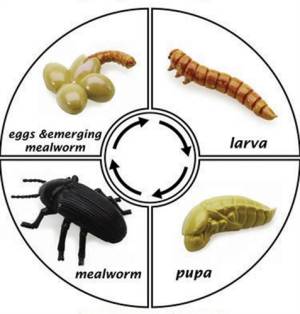
Figure 2.1: Illustration of the mealworms life-cycle
Phylum: Arthropoda; Class: Insecta; Order: Coleoptera
Appearance (Morphology)
Adult Beetle
• Black with hardened front wings (elytra) • Antennae arise under ridge near eyes • Antennae many-segmented, enlarging near tip • Shape quite variable, from almost parallel-sided to round • Head visible from top, followed by pronotum and elytra about same width • Mealworm (larva) averages an inch in length. They have a tough yellowish brown exoskeleton and are cylindrical.
Immatures (different stages)
• The larval stage (referred to generally as mealworms) is worm-like and somewhat hardened for burrowing. The egg is white. The pupa is 1.25 to 1.90 cm long., white initially then darkening just before the beetle emerges. Length of the life cycle is 3-5 months. The larval stage may molt 9-20 times.
Habitat
Mealworms live in areas surrounded by what they eat under rocks, and logs, in animal burrows and in stored grains. They clean up after plants and animals, and therefore can be found anywhere where “leftovers” occur. Mealworms are the larvae of a type of darkling beetles – Tenebrio molitor, it takes around a year for the bug to go through all of the 4 stages of metamorphosis. The stages are – egg, larvae, pupa and an adult.
Egg
The first stage of life is spent as an egg. The white bean-shaped egg is tiny and about the size of a speck of dust. The egg is sticky and is quickly concealed by dirt, dust, and substrate. It will take around one to four weeks for an egg to hatch and the larva to emerge.
Larva
The second stage of life lasts about eight to ten weeks and is spent as a brown larva. This is the stage where the insect is a mealworm. When first hatched, it is quite small but will grow to one to one and a half inches long. Since it has a hard exoskeleton, the worm will need to molt and shed its hard outer shell in order to grow. Molts will occur ten to twenty times during this stage of life. A recently molted worm will be soft and white, but the exoskeleton will quickly harden. A mealworm spends its time eating and growing in order to save up energy for the next transformation.
Pupa
During a mealworm’s last molt it will turn into a white alien-like pupa. It has no mouth or anus so does not eat. It does have leg and wing buds, but they do not function. The pupa is quite helpless and the only movement it can do is wiggle. This stage of life will last one to three weeks as the pupa transforms its organs and body into an adult.
Adult
The final stage of the insect’s life is as the darkling beetle and lasts one to three months. The beetle will be white with a soft exoskeleton. As the outer shell hardens, it will turn brown and then black. The beetle does have hard wings, but it is unable to fly. After about one to two weeks of adult life, beetles will begin to mate and reproduce. A few days after mating, female beetles will burrow into soil or substrate and lay eggs. Darkling beetles are prolific breeders and females can lay hundreds of eggs during their adult lives [(Darkling Beetle/Mealworm Information. (n.d.). Retrieved February 24, 2015, from http://insected.arizona.edu/mealinfo.htm)].
2.3 Raising and breeding
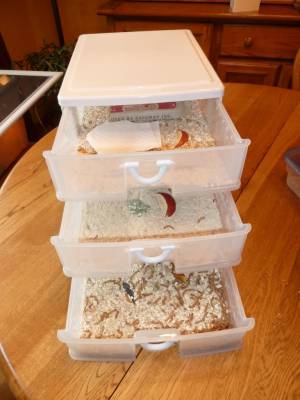
Figure 2.2: Example of an insectarium
Container
The container should have a large surface area and smooth sides. The sides of the container only need to be a couple inches higher the substrate in order to prevent the worms from escaping. An aquarium, terrarium, plastic box, or Sterilite container will make an excellent home. The container will also need a screened lid to prevent other insects and creatures from getting in and to allow airflow. Good ventilation is needed to prevent the container from getting to warm and to prevent the buildup of humidity and mold growth. If you are using an aquarium, there are screened lids available. For a plastic box you can cut away most of the lid and attach some window screen [((n.d). Retrieved February 24, 2015, from http://mealwormcare.org/breeding/)].
Food Substrate
The substrate of the container will be the food. You can use wheat bran, oatmeal, cornmeal, wheat flour, Wheaties, Cheerios, ground up dry dog food, or a mixture of these dry foods. Fill the bottom of the container two or three inches deep with the food substrate. You will have to add more food regularly since mealworms are big eaters 2).
Water
Slices of potatoes, apples, carrots, lettuce, cabbage, or other fruits and vegetables can supply water to your worms. Potatoes are often preferred since they last a while and do not mold quickly. Do not use a bowl of water since mealworms will crawl in and drown.
Temperature, Lighting & Humidity
The ideal temperature for growing your colony is around 25-27 degrees Celsius . A heat emitter may be necessary if you are in a cold climate. You will want to keep the container away from windows and direct sunlight to prevent it from becoming too warm.
Light is not necessary. A normal day and night cycle of light will be fine. You colony of mealworms will reproduce more quickly with a higher humidity, but for most areas the natural humidity in the air will be sufficient. If you live in a dry climate, you can place a smooth glass or bowl of water into the container to raise the humidity. Make sure the water container is tall enough to prevent the worms from crawling in 2).
Maintenance
Any dead worms, pupae, or beetles should be removed from the container regularly. If the container begins to smell like ammonia or becomes moldy, it is time to clean the container. You will need to remove all of the mealworms, beetles, and pupae, discard the food and waste, and clean the container. Once clean, replace the food substrate and return the insects to the container.
It is helpful to have a second container to aid in raising mealworms and keeping them odor free. After your colony is going strong, you can move any beetles to the second container where they will begin a new colony. By the time the second colony is established, the original container should have very few mealworms. You can move any remaining worms to the second container and the original container can then be cleaned and prepared to repeat the cycle 2).
2.4 Insect breeding market
Insect breeding is a fairly old trend for the Asian countries, but for the Western society it's relatively new. There are some mass-scale production companies that work on providing insects for either animal or human consumption, some of the companies work on providing insect protein flour aswell. For our product there are some competitors which are working on the same product - a DIY insect farm, where you could grow your own food.
Farm 432- insect breeding
This product is focused on breeding the black soldier flies larvas. The specifics of the flies have been taken into account and the design is very fashionable. But this product is more difficult to use for other types of insects.

Figure 2.3: Farm 432 product
http://www.kunger.at/161540/1591397/overview/farm-432-insect-breeding
Tiny Farm DIY
This is a company which sells different kits that are easy for the users to complect at home and they are insect-specific, consumers can buy different insectariums for different species.

Figure 2.4: Open bug farm by tiny farms
The biggest competition is the Do It Yourself farmers, as there are plenty of guides on making an insectarium from simple household items.
Also there are different companies like Ynsect, Next Millenium Farms, Big Cricket Farms, Protix which provide insects and products made of insects at a mass scale, also they take orders to create insectarium for specific species and have a large range of expertise in the field of growing insects.
Product Comparison table is listed below:
Table 2.1: State of art comparison
| PRODUCT | + | - |
|---|---|---|
| Farm 432 | Easy to use; Fashionable design | Can only be applied to one certain type of insects; is expensive - 375 Eur |
| Insecto | Controls to manage insectariums environment; easy to use; design | Adaptable |
| DIY insectariums | CHEAP, can build it from everyday items | No monitoring system, big space consumption, need to look for a place with the perfect temperature |
| Tiny-farms “Open Bug Farm Mealworm Kit” | Easy to use, cheap | Got discontinued but there's a guide how to make it yourself for a cheap price; takes up a lot of space; design |
2.5 Conclusion
There are many products on the market which are more or less related to insect farming. The more complex products are all oriented to a single species of insects - none of them has the flexibility to grow different types of insects by monitoring the environemntal conditions. To amp up our chances on the market a good monitoring system within the product is a necessity. The price to quality ratio will also be a major concern to be a countable competitor on the market.
3. Project Management
3.1 Scope
Scope management involves looking at the project as a whole, defining tasks and goals and then deciding who’s responsibility each task or goal is. Our task is to build an insectarium That means that it is a sor of aquarium to farm insects for animals aswell for humans to eat in a efficentn, easy and simple way [(Scope (project management). (n.d.). Retrieved March 4, 2015, from http://en.wikipedia.org/wiki/Scope_(project_management)].
The requirements of the project are to reuse provided components or low cost hardware solutions and to use open source and freeware software.
These goals are: defining the tasks, deciding who will be in charge of each task and finishing the final report and presentation.
The project contains a Gantt Chart which is designed to help with rationing the time wisely.
• Justification: A brief statement regarding the business need your project addresses. (A more detailed discussion of the justification for the project appears in the project charter.)
our company has a hole in the market when it comes to farming insects and the future of it. Insecto will fulfill this hole by farming insects cheap food for animals and humans in the future. An insectarium that is adjustable for every insect and culture.
• Product scope description: The characteristics of the products, services, and/or results your project will produce.
We are planning to create an insectarium that is sustainable and low cost produced with high renewable materials. The main goal of out insectarium is help people farm insects at their home,zoo and petshops for their animals but also in the future for themselves when it’s more socially accepted. The insectarium will have a manual ventilation, automatic heater and automatic fan to create the perfect situation for the insects to grow to their peak.
• Acceptance criteria: The conditions that must be met before project deliverables are accepted.
1 Manual adjustable ventilation
2 Automatic heater with display
3 Adjustable temperature control
• Deliverables: The products, services, and/or results your project will produce (also referred to as objectives).
• Scope Statement
• Progress Reports
• Issues Reports
• Weekly Meeting Notes
• Insectarium
• Project Success: The project will be determined successful if the insectarium sells.
To see clearly our goals below there is a WBS with all deliverables over the timescale.

Figure 3.1: WBS
3.2 Time
Time management involves creating an achievable schedule of deadlines for the aforementioned tasks or goals and then making sure that each person responsible for these aspects of the project is capable of keeping to the schedule.
Figure 3.2: Gantt chart of our team
Task that we are dealing with in this week

Figure 3.3: Current tasks
3.3 Cost
Cost management involves simply making sure that the project team keeps to the budget given to them. It requires a great deal of planning to avoid costs spiralling out of control and all essential materials, parts or labour must be planned at the beginning of the project otherwise there will be no way to guarantee that the project will remain within budget.
• Arduino Uno - 22.90 €
• Sensor DHT22 - 9.90 €
• LCD Shield for Arduino - 14.50 €
• Power Supply AC/DC 230 V AC/12 V 2 A - 7,50 €
• Jumper Wires - 4,12 €
• Wheels - 3.17 €
• Plastico autocolante - 0.00 €
• UHU Allplast - 0.00 €
(All links are incluced in “Components” part)
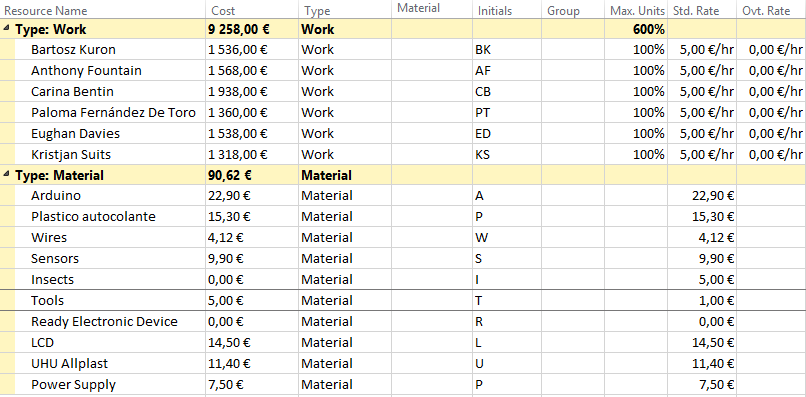
In real life human resources are not for free that is why we assumed that one hour of work of each of us is worth 5€. Thanks to this assumptions we can depict following calculations.
Table 3.1: List of resources: Human and Material
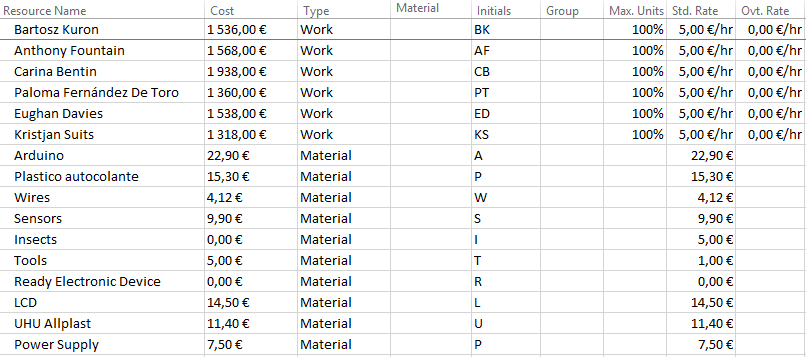
Table 3.2: Types of materials
3.4 Quality
In order to build a prototype that complies with the initially set requirements and to finish every deliverable in a quality that meets the team members´ expectations and also the EPS standards, every work produced for the project needs to pass a quality control. In quality control there are two dimensions involved: The human aspects consider how well each team member performs on individually allocated tasks, whereas the technical aspects involve how accurate the product is developed and implemented. In this project the biggest technical quality issues are concerned with the automatic and adjustable devices to control the humidity and the temperature.
Technical Quality:
Important in the region technical quality is the safety for customers or users. Receiving devices, defects and bad installations are potential reasons for a dangerous violation at home but also at the company by testing the Insectarium for example. Consequences could be fires, loosen values and a damaged image.
To avoid all these possibilities and bad influences we hire a person, who is responsible for the quality management part in our company. He should control the quality because it is important to fulfill the national and international standards with certifications and TÜV. The devices should be checked and everything should be documented after supply, after some building steps and before disposal if dimensions are right and functionalities are intact. With this structure mistakes appear better, faster and more detailed.
Human/Company Quality:
The most important quality at the in Insectarium is the functionality and the opportunity to grow insects in it, so that the construction is steady. We do not need some special materials which we can order much more cheaper anywhere. We also do not need it for using the Insectarium. It is only important that the material quality is that good, that it allows a long life-cycle and safety at home. So the glue, plastics and electronic devices should be good enough.
The quality can be improved if every team member check on each others work. But that is not necessary for the Insectarium. Important is the customer service, which is a kind of quality as well.
The team should work together, not as competitors. They should support each other and be anxious to built a qualitative save product.
3.5 People
People Management or Human Resources is the aspect of project management that aims to keep all members of the project team working in relative harmony. The aim is to reduce conflict and to alleviate any excess stress that the project may be putting on the people working on it. Project management should also involve making sure that all of the team members are doing the jobs that they are supposed to be doing and reprimanding them if they fail to do so.
Anthony Fountain Identity ( design of the whole project : presentations , leaflet , instruction movie )
Carina Bentin Sales and marketing
Paloma Fernández De Toro Design,materials,building and sketching of the insectarium ( prototype )
Eughan Davies Electrical devices and programming them.
Bartek Kuron Electrical devices and the programming of them.
Everyone Wiki and building of the insectarium itself.
Table 3.3: Responsibility assignment matrix

This is a very useful version to organisations which shows the output of activities under the accountability of a single person / function can be reviewed and vetoed by multiple stakeholders, due to the collaborative nature of the culture. :
• Perform = P The person / function carrying out the activity.
• Accountable = A The person / function ultimately answerable for the correct and thorough completion of the deliverable or task, and often the one who delegates the work to the performer.
• Control = C The person / function reviewing the result of the activity (other than the accountable). He has a right of veto / his advice is binding.
• Suggest = S The person / function consulted to give his advice based upon his recognize expertise. He has a non-binding advice.
• Informed = I The person / function requiring to be informed of the result of the activity.
To be cooperative and get connected to each other, it is important to carry on several activities besides the university. That's why we do teambuilding. at specific dates we organise to have dinner, go out,explore the city. Just to have a more fun and less stressfull way of talking about the project. it's also positive for the connecting feeling of the group.
3.6 Communications
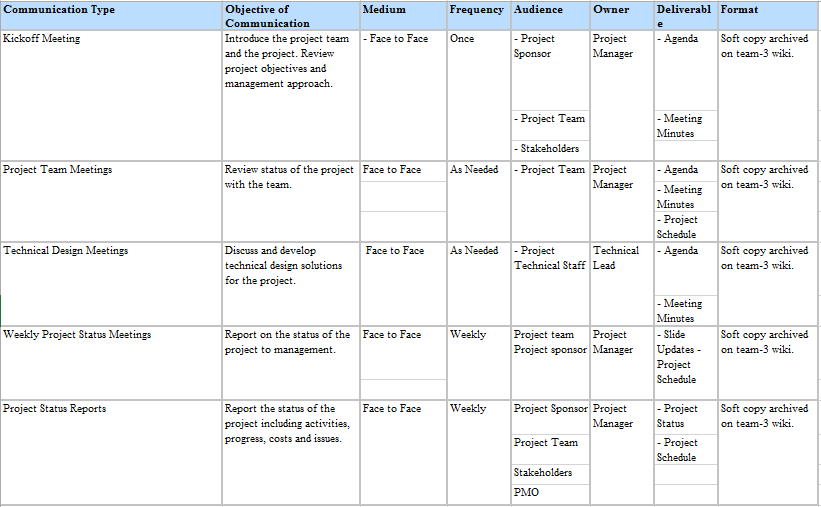
Communications Management pertains to the systematic planning, implementation, monitoring, and control of project communications activities.
The purpose of the Communications Management Plan is to describe the methodology that will be used for managing communications within the project. The Communications Management Plan is an output of the Communications Management process that details the specific communications products, events, recipients, timelines, frequency and other pertinent communications information. Project management deliverables can also be considered principal communications tools. In most cases, Communications Management is a straightforward delivery-enablement process using a relatively standard toolkit. However, in major change and business transformation initiatives, communications and engagement may represent the main focus of the project and a significant proportion of the project work effort.
The objectives of the Communications Management process are as follows:
• Define the communications needs of a project;
• Conduct a stakeholder analysis to identify stakeholders, their roles, interests, how they will impact or will be impacted by the project, and develop a stakeholder management plan;
• Define required messages, appropriate media and channels, task assignments and timings for communications delivery that will enable the project to meet these needs; and
• Ensure that the right people receive the right information at the right time to meet their needs and to achieve project objectives.
Table 3.4: Communication matrix
3.7 Risk
The aim of this chapter is to figure out the risks of our project and get some knowledge of how to better manage the risks.
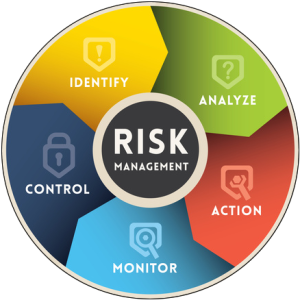
Figure 3.4: Risk management scheme
We are going to try to identify the risks that appear during the project development and the sales and marketing part. For doing that, we have been looking in the PMBOK, which says: “Risk Management's goal is to increase the impact and probability of positive risks and decrease them for negative risks. The point is not only avoiding failure, but to bring about opportunities.” We are doing a risk identification, that helps to avoid risks when possible, as well as control them in case this is necessary. For to doing that, we made columns identifying the risk, the consequence, what is the response, who is the owner and the rank.
• The consequence is the impact after the risk happens in terms of cost, time and scope.
• The risk response means what we are going to do with this risk and consecuence (if we want to transfer it, avoid, mitigate or accept).
• The owner is the responsible of monitoring the risk.
• The rank is to give a number to see how important is the risk and which one is the highest. To assign a number to the rank we have to identify and evaluate the impact and the probability. In the probability column is a very low probability (0.1); low (0.3); medium (0.5) and high (0.8). In the impact row we find a very low impact (0.05); low (0.1); moderate (0.2) and high (0.4). Finally, we have to choose our risk level in probability and impact and multiply those numbers, having a new one that will say us how important is the risk.
The management of the company is primarily responsible for risk management, but the board of directors, internal auditor, external auditor, and general counsel also play critical roles. Risk can be managed in a number of ways: by the buying of insurance, by using derivative instruments as hedges, by sharing with others, or by avoiding risky positions altogether [((n.d). Retrieved March 23, 2015 from http://lexicon.ft.com/Term?term=risk-management)].
Table 3.5: Risk Register
| RISK | CONSECUENCE RISK | RESPONSE | OWNER | RANK |
|---|---|---|---|---|
| BAD ILLNESS OF A MEMBER | Others have to work more to finish the project (if possible) | Mitigate | Kristjan/Eughan | 0,05 |
| NOT COMPLETE MATERIAL | We can´t build and finish the product/project in time | Transfer | Paloma | 0,12 |
| NOT MEETING DEADLINES | We fail the project and we can´t deliver our product to the client | Avoid | Bartek | 0,12 |
| HAVE A NEW SUPPLIER | We could make the product cheaper | Accept | Carina | 0,1 |
| NOBODY LIKES OUR PRODUCT | Nobody is going to buy our product | Avoid | Anthony | 0,02 |
Table 3.6: Rank for bad illness of a member
| ILLNESS | VERY LOW (0,05) | LOW (0,1) | MODERATE (0,2) | HIGH (0,4) |
|---|---|---|---|---|
| VERY LOW (0,1) | ||||
| LOW (0,3) | ||||
| MEDIUM (0,5) | 0,05 | |||
| HIGH (0,8) |
Table 3.7: Rank for incomplete material
| MATERIAL | VERY LOW (0,05) | LOW (0,1) | MODERATE (0,2) | HIGH (0,4) |
|---|---|---|---|---|
| VERY LOW (0,1) | ||||
| LOW (0,3) | 0,12 | |||
| MEDIUM (0,5) | ||||
| HIGH (0,8) |
Table 3.8: Rank for no meeting deadlines
| DEADLINES | VERY LOW (0,05) | LOW (0,1) | MODERATE (0,2) | HIGH (0,4) |
|---|---|---|---|---|
| VERY LOW (0,1) | ||||
| LOW (0,3) | 0,12 | |||
| MEDIUM (0,5) | ||||
| HIGH (0,8) |
Table 3.9: Rank for having a new supplier
| NEW SUPPLIER | VERY LOW (0,05) | LOW (0,1) | MODERATE (0,2) | HIGH (0,4) |
|---|---|---|---|---|
| VERY LOW (0,1) | ||||
| LOW (0,3) | ||||
| MEDIUM (0,5) | 0,1 | |||
| HIGH (0,8) |
Table 3.10: Rank for nobody likes our product
| DISLIKE | VERY LOW (0,05) | LOW (0,1) | MODERATE (0,2) | HIGH (0,4) |
|---|---|---|---|---|
| VERY LOW (0,1) | 0,02 | |||
| LOW (0,3) | ||||
| MEDIUM (0,5) | ||||
| HIGH (0,8) |
3.8 Procurement
We should follow few rules during purchasing our materials.
• Location: order materials from Portugal
• Quality: control and find the best quality
• Availibity: check availability of materials in stock
• Time: check the time of delivery
• Communication: how we can order materials (internet, phone, etc)
• Costs: cost of product and transport should be as small as possible
3.9 Stakeholders management
Stakeholder management is a critical component to the successful delivery of any project, programme or activity. A stakeholder is any individual, group or organization that can affect, be affected by, or perceive itself to be affected by a programme [(The End of Solution SalesCustomers don't need salespeople – so sales leaders need a new playbook. Download the ArticleFeatured in Harvard Business Review Score Your Pre-Sales ActivitiesIn creating customer demand. (n.d.). Retrieved March 16, 2015, from http://www.executiveboard.com/exbd/sales-service/the-end-of-solution-sales/index.page)].
Effective Stakeholder Management creates positive relationships with stakeholders through the appropriate management of their expectations and agreed objectives. Stakeholder management is a process and control that must be planned and guided by underlying principles.
Stakeholder management within businesses, organizations, or projects prepares a strategy utilising information gathered during the following common processes.
1. Stakeholder Identification
2. Prioritize Your Stakeholders
3. Understanding Your Key Stakeholders
4. Engaging and Communicating with Stakeholders

Figure 3.5: Stakeholders management scheme
Below is an excel link for the list of stakeholders and the roles of each one of them:
Table 3.11: List of stakeholders and their roles

3.10 Conclusion
Our task is to build cheap, good and sustainable product. To do that we have to responsibly manage our project and we can’t forget that project management consists of many parts such as time, people or quality. To achieve success we have to be strong one-minded group and have clear goals and roles in project. To provide best efficiency and best time management we prepared gantt chart with all important deadlines and milestones which are assigned to people. Thanks to that we know who is responsible for what and when it should be finished. We also prepared costs list because it is very important to know how much money we are going to spend. Our budget is equal to 100 euros and our calculations show that we are going to spend about … euros because we want to build fully automated system. To provide excellent quality we did a lot of research and choose the most efficient, suitable and only original materials. We spend half of budget on electronic devices and half of budget on shelter. Of course to provide good quality also people are very important, thanks to belbin test we were able to find our strongest sides and it helps us to divide roles and share work in team it helps us to find our leader – Anthony or plan maker Carina. We can’t forget about risk connected with every project that’s why we prepared risk management and we found that we can fail because of many factors. For example our budget is small and there can suddenly appear unexpected costs, we can also miss our deadlines or materials can have less quality than we expected. During project management we need also to define our stakeholders in our case it is simple because our stakeholders are mainly supervisors, teachers and team members.
3.11 Weekly tasks managed on facebook
Week 1
• Anthony & Bartek Kuron : Focus on the control and software side of the Insectorium (Electrical/control/software devices in the Insectorium)
• Anthony Fountain : focus on Presentation and media (take the pictures with a camera )
• Paloma Fernández De Toro : focus on the building design/choice of size/structure/material of the building the insects will live in.
• Carina Bentin : Marketing,reports,insect research.
• Kristjan Suits : Work alongside Carina with the Insect research and look at the environment the insects should live in.
Everyone should buy a logbook and keep a note of what work they are doing in the project so that if worst comes to worst and the project doesn't work we can show the lectures our work. If anyone is unhappy with their role just let me know and we will try to find a solution. Great discussion today lads and lassies,communication is key
Week 2
Okay so for tomorrow:
• Bring something that defines you like a sketchbook, laptop , camera , engineering …. whatever is possible for the pictures to make it look more fun.
• Do some research tonight about which insects is the best to grow and if is it the best for animals OR humans or maby both. Also which has the highest profit. we need some facts and then decide.
• During the research write down the main important questions you think is important to ask the teacher thursday.
Week 3
• Anthony Fountain : Presentation and leaflet.
• Bartek & Eughan : Gantt chart ,familiarise with arduino software,and look at control devices for insectarium.
• Carina Bentin : Report,research mealworms.
• Paloma Fernández De Toro : Draw a rough sketch of the insectarium,and if possible design 2D/3D drawing online.
• Bartek Kuron : Insect research ,fill in the motivation and introduction section in the wiki .
Unless there is a deadline for your tasks (like Anthony for the presentation and leaflet ,and me for the Gantt chart ) we should make the deadline Friday to finish these tasks.
Week 4
• Bartek : make the gantt chart in wiki for better watching and the add the main tasks into the chart on wiki, what they said tomorrow
• Paloma : try to design the new insectarium
• Carina : add some wiki stuff, marketing
• Kristjan : find out: -the whole proces of a mealworm till the bug(how long every live, environment, temperatur in each phase) and please replace it on wiki on the introduction (2. Report) we have to change it
• Eughan : the point on wiki: functional tests: just mention, what a customer would like to have and what we may have in our product…also please detail the requirement-lis
Week 5
• Kristjan Suits: figure description, project management tasks 3.6-3.10
• Anthony Fountain: project mngt. tasks 3.1-3.5 -presentation -replace presentation from interim report
• Bartek Kuron: Gantt Chart in pöanning section -diagrams and materials
• Eughan Davies: funktional tests (Work with Bartek)
• Paloma Fernández De Toro: topic ethical+deont. Concerns in wiki -design the handle for open the insectarium
• Carina: picture description -table description -reports of the meeting -marketing part on wiki
And everybody can think of practical design dor our insectarium because:
• We need the materials
• For our devices
• For the meeting on tuesday
• For the interim report soon
Week 6
If you look at the other wikis of last years you can see that they actually did some research about every sustainable aspect of their project and posted it on the wiki. So the teacher already probably checked it but we have to fix this.and everybody need to help in this part. so —→>
• Anthony : introduction, social part (suppliers , employees , producers )
• Paloma : introduction, social part (distributors, costumors )
• Bartek and eughan : environmental and economic part
• Kristjan : life cycle ( insecto aims , materials , manufacturing )
• Carina : life cycle ( distribution , consumer use , recycling )
And then maybe conclusion we can do together
Just do some actual research about your points about what, why,where,…
WORK FOR THE PRESENTATION:
• Anthony Fountain : Introduction
• Anthony Fountain : Problem
• Kristjan Suits -State of the Art
• Bartek Kuron : Project Management
• Carina Bentin : Marketing
• Paloma Fernández De Toro : Ethics and Deontology
• Anthony Fountain : Sustainability
• Eughan Davies : Proposed solution (Design, electronic and materials)
• Carina Bentin : Conclusions
We only have 15 minutes for the whole presentation, so prepare your presentation to be like 2-3 minutes, NO LONGER PLEASE
Week 7
Okay so guys because we have to correct our issues on the wiki in 1 week. i suggest that everybody does correct hes own part on the wiki by tuesday. so we can have a meeting and see if everything is corrected in the right way. this way we will have a good fresh start to go further with the project
• Kristjan: complete State of art kristjan - inches, farenheit ?
• Kristjan, Anthony: explain that it is adaptable for different insects
• Paloma,Bartek,Eughan: explain where the electronics are going to be in the insectarium with a - design
• Paloma: ethics liability
• Eughan: electronics, schematics ( not sure if it was okay or not )
• Anthony: create pdf and upload wiki ( report )
• Carina: glossary
• Eughan: send picture to Benedita
• Bibliography –> everyone !
Week 8
• Eughan and Bartek : numbers , CPU , PLC , voltage
• Kristjan : state of art comparison. quantity of bugs , price.
• Eughan and Bartek : schematics electronics changing the heater to make it work.
• Paloma : dimensions of the insectarium in architecture part
• Carina : marketing
• Anthony : start with instructionmanual/ movie / poster maybe ?
• Everyone : glossary
• Everyone : bibliography
deadline tuesday 21/04
Second part week 8
• Paloma : upload architecture
• Everybody : correct his/her red part
• Kristjan : state of art bullshit comparison
• Anthony : make project management table - glossary part !
Week 9
• Everybody : captions and links in bibliography for pictures
• Bartek & Eughan : make a detailed electronic schematics
• Electronic schematics open source program = fritzing.org/download or 123dcircuits carina : report kristjan : detail description of state of art in one page for paper part. anthony : storyboard , concept movie.
• Paloma : improve design , architecture part.
DEADLINE : TUESDAY 28/04
4. Marketing Plan
4.1 Introduction
The aim in this chapter is to analyze our market first so we know for which users we can provide our product.In the present age this part is very important because we have much of demanding customers. Every market has to use the right practices to get importance and attention. Then again a company can be profitable and grow. When we have our target-group we can decide more or less, which strengths, weaknesses, opportunities and threats we have (SWOT). Than we decide the strategy for our objectives, and that function after we segmented our market. Then it is possible that we´ll be ready and prepared for our positioning in the market and we pattern an adapted marketing-mix for the highest exhaustion. Before we start we have to check the budget we have and how (so strategy and control) we go further with our marketing. In the end our conclusion.
“Marketing is the process of planning and executing the conception, pricing, promotion and distribution of ideas, goods and services to create exchange that satisfy individual and organizational objectives.” (Definition of marketing from Bennett in 1988)
First of all we want to clarify our aims on which we build on in the following:
• Aim: Making the food healthier
• Mission: Making the food production more sustainable for animals also for healthy and happy pets.
• Company aims: Development of new insectarium (personalized), which enables high income and profit distribution.
• Marketing aim: publicity of about 15% inside Europe in two years or less.
4.2 Market Analysis
The following picture shows the relationships inside the environment first, to get an idea how each section correlate to others.
This is a small general description of the relationships between the different environments as related to the company.

Figure 4.1: relationships in environment [(What is marketing environment? How many types of marketing environment? Explain the influence of micro and macro environment on marketing. (n.d.). Retrieved April 7, 2015, from http://www.josbd.com/Market_Environment.html)]
Our product in 2015 will be an Insectarium in which one can breed mealworms. Our aim is to build something innovative, something new and from what people know, why they are going to need this. They should like it because of the beautiful design, it could be a decoration for the habitation but also act as a feeding station in zoos for animals. Furthermore the insectarium is going to be very sustainable with little power, do not need much space and is very easy to handle. There is no need for a continuous custody or maintenance. Moreover the product is extensible with some gadgets one likes or needs to have. Initially the Insectarium is just to grow mealworms to feed animals with it. But certainly it is possible to put other insects in it if the environment is like the same. It should be provided to small farmers, zoos and private persons but also to little pet-houses.
At this point of time we are the only one in the European market, who is going to produce a product for mealworms to grow. Because of the location, where we plan and develop our product, it is sensible to provide the insectarium in the European market at first. If the demand will increase in the future we are able to sell it in other countries, after we made a new competitor-analysis for the new environment and market we will go into. But first we will have a look at the appropriate market and its environmental influences in the following.
4.2.1 Environmental-Analyses and -Arediction
4.2.1.1 External Consideration:
The goal is to realize the chances and risks of the market and constructing on that to create a prediction of the prospective development [((n.d.). Retrieved April 8, 2015, from http://kaufmann-werden.de/sites/default/files/dokumente/Situationsanalyse, Marktanalyse.pdf)]:
- competetion analysis
- industry analysis
- analyze of the micro- and macroenvironment
4.2.1.1.1 Competition Analysis:
1) identify the competition companies
→ other companies, that offer comparable or the same products, for the comparable/ same prices and services. Also companies, that offer the products for the same using 7).
2) realize the goals of the competition
→ why are the competitors on this market? → which are their motives?
3) see trough the competitions´ strategies
→ the similar the strategy, the immediate the competition. We must have a look on strategic groups of a company, that pursue the same strategy on the same target-market. It is also important to see the competitive relations inside the strategy groups.
4) form an opinion about their strengths and weaknesses
→ based on the secondary data, personal experience and hearsay inside a sector.
5) assess possible reactions of the competition
→ it is better to know the business-mindset for assessing the reactions and actions of our competitors.
6) determine competitors whose position should be assaulted
4.2.1.1.2 Industry Analysis:
Analysis of the five competitive-strengths (rivalry between the existing companies inside a section, bargaining power of the suppliers inside a section, bargaining power of the customers inside a section, hazard of newcommings inside a section, hazard of substitution-products) these points have to be analyzed in detail and carefully 7).
Analysis of the market entrance and escape barriers for example high capital demand or a permanent customer loyalty.
4.2.1.2 Internal Consideration:
The goal is to reveal the captive strengths and weaknesses for being successful within the scope of the todays and prospective situation 7):
- value chain analysis
- strengths- weaknessesprofile
- experience curve analysis
4.2.1.2.1 Value Chain Analysis:
The value chain shows the steps of the production in a organized string of activities. As a controlling- and planning tool we use a portfolio-analysis and last the SWOT-analysis advancement of the strengths-/weaknessesprofile 7).
4.2.1.2.2 Strengths- and Weaknesses profile:
The profile is segmented in three stages 7):
1 - determination of the critical recourses: included are the following points, that should be assessed: location, space, financial situation, marketing, assortment, logistics, quality of the personal, leadership, organization
2 - determination of the specific responsibilities: of the strengths- and weaknesses profile one can read out now the specific responsibilities of a company, but also the weaknesses.
3 - determination of the strengths and weaknesses: Strengths and weaknesses are not absolute bulks and it is only possible to determine them by a comparison. That means, that the strengths- and weaknesses profile contains a competition-analysis for the selected competitors.
4.2.1.2.3 Experience Curve Analysis:
The most important base for information provides the operational accounting. There again above all the cost accounting, the annual accounts (balance, profit and loss statement) and the operating statistics. The effect of the curve is a measurable empirical phenomena and the average costs and therewith the product minimum level decrease with raising experiences. The experience curve is regarding to a few causes:
Learning process of the personal and better organizational processes by raising experiences
Usage of low cost technologies which investion volume will be profitable with a high number of pieces
Fixed cost degression. So the fixed cost distribute on a high number of pieces thus the fixed costs of just one piece will decrease.
Decrease of the running costs. For a higher number of pieces a higher bargaining power towards to the suppliers 7).
4.2.1.3 Micro-Environment:
The environment of a company pretends the parameters for the activity of the commercial undertaking. Set by the parameters of a high amount of systems and arrangements. They are especially consist of five components:
4.2.1.3.1 Internal Perspective
Every company has an internal perspective which refers to the internal environment of the companys´ organization. So in our case we are a “company” of 6 students from difficult countries and with different faculties. In this way, every member gets tasks and manages this parts for one´s own for making it possible to realize the product in time 7).
4.2.1.3.2 Customers
After analyzing the target and prospective market, we classify the potential customers we are going to approach. The product selling is more individual, because our target market are short farmers and short stores with some expansions, which make it individual for the customer.
Against the backdrop of having no serious competitors, we do not have a need on looking after customers in Europe, whose behaviors and reasons, why they are interested in other companies´ products, which are nearly the same like we are going to offer.
Thus we are trying to convince new and potential customers with a good surface impression for the new sustainable product on the relationship towards the futures market. To feel certain to be fixed in the heads of the humans, so if competitors are going to attack us, we are a better known and confidential company at all. For being a formidable opponent and build a save standing.
Concerning the background, that we already have a product and have to search for the customers than the other way round, like normal, do we have to search for customers who have the needs that we offer. We are like to address our insectarium to customers by internet, leaflets and promotions. For instance by going to potential stores and hand out the leaflets for anyone interested.
In the run-up to the election of our target group here are the first possible customers we want to approach:
Table 4.1: possible target customers for the direct distribution [(Jardim Zoológico de Lisboa - Homepage. (n.d.). Retrieved April 8, 2015, from http://www.zoo.pt/site/index_en.php)]
| company | country | task field |
|---|---|---|
| Jardim Zoológico | Portugal | Zoo |
| Bellendorf | Germany | butchery |
Table 4.2: possible target customers for the oblique distribution [(Tierbedarf, Tierfutter, Tiernahrung günstig kaufen bei zooplus. (n.d.). Retrieved April 8, 2015, from http://www.zooplus.de/content/aboutus_general)][(Ãber uns. (n.d.). Retrieved April 8, 2015, from http://www.fressnapf.com/de-de/überuns/international.aspx)][(ABOUT US. (n.d.). Retrieved April 8, 2015, from https://www.zoetis.co.uk/about-us.aspx)]
| company | country | task field |
|---|---|---|
| Zooplus AG | Germany, Munich | food and complements |
| Fressnapf | International | food and complements |
| Zoetis | International | animal health |
There are some possibilities to distribute and to reach the customers.

Figure 4.2: chosen distribution channels [(Skript/Handbook TVVS, Germany university, Mr. Stefan Eghbalian)]
We would like to reach our consumers per direct distribution on the one hand but on the other hand also per oblique. Per direct distribution we offer our product for private persons with pets or for little farmers in the internet on a homepage, which is also orderable there. That enables customer contacts but also obligation. Which is turn to a confidential and the result is loyalty.
Per oblique distribution we think of Franchising (a company gets the law to sell the product of another company). We sell our Insectarium to little pet-stores via B2B (Business-to-Business). The advantage for them is on the one hand to feed their pets healthier and cheaper, on the other hand they have the chance on profit by selling our product more expensive. So they can be motivated to be our customer. Otherwise we have an advantage as well because of the present of the product for the customers. In contrast to the internet 12).
4.2.1.3.3 Intermediaries
Intermediaries have nothing or less to do with the product itself. Rather with the question, how to distribute on which market. In instance if a company has a bad infrastructure or just a few Know-How about the market they will join intermediaries who could be very helpful. Also for getting a better proximity to the market and to the customers. But for our product and our notion to distribute, intermediaries are not useful- at this point of time- when we have a look at the future we have to pass time to think about further distribution 7).
The only kind of intermediary are the retailer, which are coincident our customers. They can use the Insectarium for a better and cheaper food or resell it to further customers. But this approach is only defined as an intermediary, if they resell it and the end consumer buy our new product.
4.2.1.3.4 Suppliers
Suppliers help us to provide the resources that we need for making the insectarium completely.The quantities of providers are huge and that makes it more difficult to find the best one for our materials.
Apart from the ISEP University we do not have any suppliers right now. But for the future, while dealing as a company, we thought about a kind of cooperation with healthy and sustainable oriented companies to save money and for providing the product cheaper. We know which devices we installed so we can look after ecological suppliers. Furthermore our companies´ aim is to be sustainable therefore we also have to choose suppliers that are fulfill these claims as well and have a inexpensive offer.
Another point is the communication between the supplier and our company. We think about a networking with a platform of suppliers like SAP (Software, Anwendungen, Produkte in der Datenverarbeitung), MS Dynamics CMR (Customer Relation Management) or Supply on. Suplliers are all on this platform and it is the best way to communicate, compare and choose the appropriate supplier for the company.
4.2.1.3.5 Competitors
At this point of time we do not have serious competitions and every company could become a customer or a competitor for us, according to the aims of the companies if they want to cooperate or to compete. The once who offer insectariums are producing in the western world, which is not our target location and we are not a part of their environment at first. When we have a look into the future it is possible, that our product becomes more attractive and the periphery increases which requires a new market analysis including a new competition analysis. But at this moment Insectariums are only produced and built by the customers´ own which we can describe for one competitor. If people only want to grow little insects, not particularly mealworms, and put no value on design or special keeping, they might buy Insectariums which were built by private persons with a bad construction on the cheap. They order their self-made Insectariums for example at Ebay, which are also individual items. But we think that customers only bought it in the past because they have no idea and time to make it for themselves. But mainly because there is no existing market right now and the costs for a beautiful sustainable one are not much higher than an unattractive and inefficient one.
Regarding to the competitors which were mentioned in chapter “State of the Art” it is nearly the same. There are many products on the market but the more complex products are all oriented to a single species of insects - none of them has the flexibility to grow different types of insects by monitoring the environemntal conditions. But of course these are also seen as competitor, especially when the customers do not emphasize the good design, then they would by from Tiny Farm DIY for cheap furthermore easy and small. Nevertheless it is not a kind of our direction of product because we have customers that emphasize the design also and the efficiency for a bit more expensive.
So in the best case, but not our aim at first, to get a monopoly on this specific kind of market.
If we consider the other side of the Insectarium there are suppliers that provide also food for animals. Only another kind like corn or hay. Perhaps there are suppliers in the world but it is another kind of animal food and not comparable with ours. Because of that we focus on farmers and pet-stores that appreciate healthy food for animals. It is not our aim to reach other customers at first.
Table 4.3: possible target customers of other forage producers [((n.d.). Retrieved April 8, 2015, from http://www.forfarmers.de/)]:
| company | country | area |
|---|---|---|
| For Farmers | NL | international |
| Agri Firm | NL | international |
| Agravis | Ger | international |
| Denka | Ger | international |
| Bröring | Ger | international |
| ATR | Ger | international |
4.2.1.4 Macro-Environment:
The macro-environment influences a companies´ development vastly, but conversely the macro-environment could not be influenced by the company. Thereby an analysis of the ruling and future environmental conditions have influence on the appeal of different strategies, it reveals chances and risks. Regarding to our Insectarium project there are a few affects that will be explained in the following:
4.2.1.4.1 Demographic- Environment
The demographic component comprises aspects like the population development, geographic distribution, age distribution, birth and death. An example is the trend of the continual aging population, that influence the market for the pension plan [(Analyse der Makroumwelt anhand von sechs relevanten Komponenten. (n.d.). Retrieved April 8, 2015, from http://derwirtschaftsinformatiker.de/2012/11/15/corporate-management/analyse-der-makroumwelt-anhand-von-sechs-relevanten-komponenten/)].
Regarding to our project we do not involve the trend of the aging population, but the trend of the increasing importance of healthy. Evermore people put emphasis on their food to feel better. The older ones, reagrding to the animal feed are not interested in giving their animals good food like the people of today. From the beginning younger population pays more attention which quality comes out of the animal for example eggs even the meat from the cow for example. The younger generation will not increase, but the market for these are big enough for our aim.
Another point is the geographical allocation. We start in Europe, because there is a better location for the market entry furthermore insects are more used as animal food. In other sections more for humans, and that is not our aspiration.
4.2.1.4.2 Economic- Environment
The economic component comprises factors like buying power, income distribution, saving rate, monetary assets, living costs and jobless rate. An example would be the adaption of the own assortment to the buying power and the monetary assets of the own target-group. If the company is bounded on a region it would not make sense for example to provide a luxury product on the market, if the buying power is too low for the purchasing of a product like this. This analysis should also incorporate some forecastings 14).
The buying power will not be very high because the market is too small at this time. Also the income distribution will not have a high effect on buying the Insectarium, because there is not much money needed for buying and enjoying the product, if anything-people could save money by feeding their pets with insects, that are self-made at home which need nothing to grow, just once at the first time. And that is the purchasing. So we need not keep an eye on this topic of analysis.
4.2.1.4.3 Ecological- Environment
The ecological component comprises trends and changes of the ecological nature for example the environmentalism, the scarce resources, the public environment politic and the increasing pollution. An example would be the coconscious car driving with different drive engineerings, that function with renewable energy 14).
This a point we must have a look on. Thus the scare resources and the increasing pollution our product gets a high assessment against this process. Especially in Europe the importance of the environmental pollution increases and with that the value of alternative resources. Of course, our view lies only on the animals, but that is, what it could start with. If everyone would improve its own area, the environment would get benefit out of it. And the sustainable feed for animals improves: the environment by producing the food without any chemicals, by a better living room for the animals, the nature resources, no changes of the ecological nature and a natural breeding. So we do not need to be stressed or careful with operating this product, also not in the Europes future.
4.2.1.4.4 Technological- Environment
The technological component considers the circumstances of the technological nature. Also the duration of the product life cycle, the requisite expenses for researches and development, possible innovation fields but also regimentations of the laws, which occurs constraint in the technical development. So the product life cycle of a car for example is getting lower and lower. Earlier the cars were produced up to nine years, nowadays only four to five because the humans expect innovations and specials 14).
We do not have a product that has or needs a short product life-cycle. It is not a kind of product, people want to have because of a luxury requirement and for their state, like a car, where everyone is best, who drives the newest and most expensive brand. We offer a product that is for a better quality of living. Of course one can extend some devices on it, so it would be a bit more technical but that it was. We do not need a high standard of technique, the product can be built with the easiest devices that already exist for a long time and which make the handling with the Insectarium without a big fuss.
4.2.1.4.5 Political- Environment
The political component deals with regulatory influences like competition-law, anti-trust-law and consumer protection. An observing trend is the increasing influence of the EU-law, that constantly develop new regulation according to which the companies have to fit to 14).
The increasing influence of the EU-law is not that bad for our distribution because, as in the economic part said, we have a sustainable and nature product on that is no danger by and for anyone. Rather there is a possibility that we will get any support because of the production of something good. So we have influences of the political environment nowhere.
4.2.1.4.6 Social- Cultural- Environment
The social-cultural component is concerned with society by itself. It describes the core values like work, marriage/ family and fairness. But also the relationship of the humans to themselves, to fellow human beings, the nature and institutions. Furthermore culture and subculture. An example is the visible trend of the social-cultural of the LOHAS ([L]ifestyle [O]f [H]ealth [A]nd [S]ustainability). Here increase the need of healthy food and fitness. For example fast-food-companies increased by offer biological food. Also employer are evermore interested in the health of their employees 14).
The main point in this chapter is the culture for sure. In Europe it would not be the deciding point to buy our product, like in the western, where the humans consume of insects is much higher than here. It has not a high meaning, only in a way of culture that describes the good behavior against the worlds environment. Furthermore during talking about good behavior, some people or farmers care about the animals health by a good handling in a species-appropriate husbandry. And if farmers care about the happiness of their animals, they are also interested in good, healthy and inexpensive food. That is why these persons are our target group. Maybe it would have impact on other farmers, that we do not reach for the first time, adapt themselves. We stand for the fair farmers and animal breeders, who are already mentioned as the chosen customers in the distribution.
conclusion:
The DESTEP-analysis is an important tool for the marketing analysis however it is insufficient for the deciding for or against the market entrance. The SWOT analysis for example can be an added tool or analysis for being on the save side. So the DESTEP-analysis is important but insufficient alone. For a reliable and suitable marketing analysis a mix of several tools should be chosen.
4.3 SWOT Analysis
The SWOT-analysis is a tool that identifies the *S*trengths, Weaknesses, Opportunities and Threats of an companies´ organization. The analysis assesses what an organization can and should not do as well as its potential opportunities and threats. The method of SWOT analysis is to take the information from an environmental analysis for our product and separate it into internal (strengths and weaknesses) and external categories (opportunities and threats) that will be mentioned in the following 12):


Figure 4.3: strengths, weaknesses, opportunities and threats of the company
4.4 Strategic Objectives
To develop a strategic marketing plan on that we can measure our past, future and competition it is necessary to frame the strategic objectives that can describe by aims or milestones of the product for at most the next five years:
Table 4.4: The objectives
| Time | Description |
|---|---|
| 2015 | get ready the production of the whole insectarium including all possible devices |
| 2016 | sell at least 5 insectariums inside Europe with no special distribution |
| to 2018 | get a publicity of about 15-20% of the humans |
| to 2020 | increase the amount of green farmers and the resulting nourishment of about 10% |
| 2020 | more than 25 customers of all sorts for the insectarium |
further objectives:
• Development of new Insectariums for other insects, that could not grow in the planned product.
• More personalisable by special designs or devices.
• Increasing benefit through the years.
• Stay the most-known producer of Insectariums.
• Customers satisfaction.
4.5 Segmentation
Definition:
“Market allocation in buying-groups with different needs, characters or mode of behavior, that require different products and a nuanced Marketing-Mix.”
Regarding to our product and its market analysis like the adjusted SWOT analyses we can look further with the market segmentation. By reference the SWOT analyses we can address our customers specifically when we segment them into different market sections.
We already had a look at the micro-environment criteria we listed like geographic-, demographic-, psychographic- and behavior-aspects:
Summarized:
Location: We are located in Europe, which is a big location but especially for the beginning in Portugal. Portugal has round about 10.5 millions inhabitants, Europe 742.5 million [(Demographics of Portugal. (n.d.). Retrieved April 13, 2015, from http://en.wikipedia.org/wiki/Demographics_of_Portugal)][(Demographics of Europe. (n.d.). Retrieved April 13, 2015, from http://en.wikipedia.org/wiki/Demographics_of_Europe)]. There is a different climate in each stage of a year, but in all, Europe has no country with much different climate zones. Furthermore we focus on humans age of about 20 years up to 35. Preferably that are private, in animals and food interested young people, young farmers or zoo holders. There are no requirements on the income of each customer, because there is no need of much money for our product. There is also no need on a high knowledge or a special certification. But it is possible, that some people get a problem regarding their moral or ethics, to eat creatures. The lifestyle of the customers have to be value-centered, if they should care about their and the animals´ healthy also the better environment by pollution reduction. Furthermore they have to be innovative and open for new experiences for instance by tasting animals. Our customers have special purchase-reason, more or less, because regarding to the normal thinking and handling people there is no action by improving the environment or the better food for animals for again getting better results for humans. That would be first-time not regular buyer, who require no high customer loyalty. The approach to the Insectarium will be positive most, for a few of them hostile.
Thus, we move in a sector that pays attention on the healthier life and better environment firstly regarding to the animals. Preferably for small customers, so small farmers and small zoos.
segmentation-features:
Regarding to these points we initially segmentate on the bases of the demographic-psychographics-features for consumer-goods because its highly probable, the market with the highest influences. In other words based on ethics, social class, lifestyle and personality like the open for new. A multistage segmentation is presented. The challenge we have for an efficient segmentation is the measurability. It is difficult to measure something, that do not exist, so we only can measure, when something is implemented, when we talk about the Insectarium by itself. But we can measure the need for the animal food, each farmer or zoo would need for the efficient feed.
For example:

Figure 4.4: Feeding amount with insects
4.5.1 Four Types of Market Segmentation:
- high-volume-marketing:
Undifferentiated speech of all market segments like “ one size fits all ”
- target-group-marketing:
Adaption of the product-offer and the Marketing-Mix for one or more market segments
- niche marketing:
Adaption of the product-offer for narrowly defined market segments
- micro marketing:
Offer of individual products and personalized Marketing-Mix like “ One-to-One-Marketing ”
Decision:
In reflection of these options we decided for target-group-marketing. The explanation for that are various aspects that were mentioned above. We can offer our Insectarium for more and wide segments and there is no need or requirement for special adaptations for customers. With the only difference that we do not really adapt the product-offer, but the possibilities we have, to modify the Insectarium, is for one or more segments interesting.
The advantage is that we have opportunities to get a supporting by companies which are interested and coincident our customers. Furthermore we have no political trade barriers or kinds of laws that prohibit or restrict our commerce. A further advantage is, like mentioned in the SWOT analysis, that we may can use the knowledge of each team member who concerns the “home” market for a better entry when it is time.
4.6 Strategy/Positioning
Assessment of target markets:
We choose our market by reference to the assessment of our target markets. There is an attractive market segment in the accrual rate of the humans. And regarding the food, the relation increases disparate. So the food will become more important for the human increasing because of its scarcity. With that we can use the accrual as an advantage.

Figure 4.5: determination of the operating market segments
1 - lifestyle segment (value-centered)
2 - social class ( who cares about the environment and pollution)
3 - personality ( new experiences, innovative)
4 - ethical affinity ( ethical to eat creatures for a better healthy)
5 - nacionality ( for now it should be an European)
4.6.1 Differentation and Positioning
Goal:
Adjust the companies´ strengths with the demands and opportunities of the market respectively of the individual segments
Approach in two steps:
• Identification of a customer group, from whose few we have an exceedingly offer and that differentiate us with an advantage against other provider
• Positioning of the product in the heats of the consumers.
–> Differentiation and positioning have to deliver the answer to the question of the buying prospective buyer “ Why should I buy exactly THIS product?”
4.6.1.1 Differentiation:
To get an idea of the correlations of the advantages in the market in the following:
The new BCG- Matrix for the differentiation:

Figure 4.6: Strategic Environment Matrix 12)
When we have a look at a high advantage and high potential to competitive advantages, we move in the sector “ specialized”, as seen in the picture. This is our differentiation to be discharged from other coming components in the future.
4.6.1.2 Positioning:
Consequent, straight, clear and unique following of a position regarding to our target-market as compared to competitors´ products.
With the background, that we do not really have a serious competition, we raise these as once, that supply other animal food to the same customers, who we want to reach as well.
These competitors were already mentioned in chapter: 4.2.1.3.5 competitors (Table 3)
• Position of a product is a bunch of emotions, feelings, impressions and sentiments that consumers saved in their head as compared to other products
• Customers define the position of a product by means of the important buying relevant features
• Aim: definable, ideally unique position of the competition in a clear defined market
• Challenge: we are successful, if we are different especially in that way like the customers whish
»Positioning begins with a product, a commodity, a service, a company or even with a person. But positioning is nothing what happens with a product. Positioning is that, what happens with the thoughts of all those interested.« Ries/ Trout 1981 12)
4.6.2 Strategic Options of the Positioning:
1. Reinforcement of the present position
2. Finding a vacant position and fill it (with new products)
3. Repositioning
Decision choice and implementation of positioning strategy:
4 steps:
1) For the structure of the intended position we need the identification of possible competitive advantage
2) The right decision of the competitive advantage and positioning features
3) Develop of a positioning strategy
4) Communicate the competition strategy on the market
4.6.2.1 Choice and Implementation of a Positioning Strategy:
Identification of possible competitive advantage:
• Differentiation over the product
• Differentiation over services
• Differentiation over employees
• Differentiation over image
• Differentiation over origin (cult) (cars from Germany)
Regarding to these possible differentiations we identify the competitive advantage with the differentiation over the product.
Table 4.5: development of a positioning strategy, scopes for design
| price: | cheaper | similar | more expensive | |||
|---|---|---|---|---|---|---|
| benefit: | more | more for less | more for the same price | more for more | ||
| similar | the same for less | “We can do the same as well” | - | |||
| less | less for less | - | - | |||
Regarding to Table 5 we position ourselves in “more for more”. We offer a product with a better quality with a beautiful design and with helpful devices for the insect growing. One has to pay more for that, what should be paid for a normal, self-made Insectarium with no devices, not that beautiful and therefor a worse breeding of insects. So one can benefit from our product just by paying a little bit more money.
Table 4.6: criteria for the meaning of the differences of the positioning
| features | what does the difference afford? |
|---|---|
| important | the difference afford a high added benefit for the customers |
| distinctive | the competitors do not offer something of the like or the company can deliver it in a unique way |
| superior | the difference is the best solution for reaching a special goal |
| arrangeable | the difference can become clear and visible, also explainable for the customers |
| not imitable | the improvement cannot be copied by the competitors |
| affordable | the purchaser allow oneself to pay for the difference |
| economic | the company can market the difference profitable |
Implementation of the competitive advantage
• Amount of competitive advantages
• Unique Selling Proposition (USP)
• Emotional Selling Proposition (ESP)
• possible mistakes :
- under-positioning
- over-positioning
- unclear- positioning
- implementation of the competitive advantages
Table 4.7 : Alanlysis of competition advantages
| Technology | Costs | Quality | Services | |
|---|---|---|---|---|
| assessment of the own position (1-10) | 8 | 4 | 8 | 2 |
| assessment of the competitions position (1-10) | 1 | 2 | 2 | 1 |
| necessity of urgent improvements (big-middle-slight) | middle | middle | slight | slight |
| bankability and velocity (big-middle-slight) | big | big | big | big |
| competitors ability to improve themselves (big-middle-slight) | big | middle | middle | big |
| guidance | bide | bide | bide | bide |
Currently we have no guidance because of no competition and that is why the competitors abilities are big. We are the only once, and they can measure themselves on our product.
4.7 Adapted Marketing-Mix
We refer to a Marketing-Mix and adjust each position to our product marketing. The Marketing-Mix is constructed like the following:
 integrative, analytical consideration of the Marketing-Mix
Figure 4.7: Construction of the Marketing-Mix
4.7.1 Product
We as the team Insecto offer an innovative Insectarium which kind is not available on the market right now. It is a kind of box, which is closeable for holding the temperature and air features inside the gadget. The idea is to breed mealworms in it to grow them and use them for the feeding as healthier food than usual. And we want an association regarding to a green thinking by the people. The quality is characterized by many features that are important and attractive for our consumers.
The devices will be performed by power from the socket but also from solar. These are electable and installable individually according to the aim of breeding and insects. This is a kind of service, which the production built as individual product which is for ones chosen insect. Another kind of service will be our tasting on some promotion areas. We use environment friendly plastics and devices which are reusable. Furthermore it is such a good material that there is no need to renew it. Furthermore one can use the Insectarium in several aspects. So because of the fact that it is not only for mealworm and not only for animals but also for other insects and for human meal production the usability and usefulness are very high. We make a good decoration inside the Insectarium as a livingroom. That is also for the best design which people can think of for growing insects.

Figure 4.8: The product, Insectarium
Consumend we have: quality, styling, extras, name, equipment elements and a customer service. We also want to offer a warranty for not functioned devices.
4.7.2 Price
For becoming a direction of the price of our product we have to take a look on the existing market price, our calculation, price presentation and the price differentiation. So first we should have a look on the market prices for Insectariums. Because there is no production of anyone, we consider private person who sell their self made products in the internet. Furthermore we can compare the price with some producers of a normal aquarium or terrarium. The price area is from 10€ up to 300€ for the same size but of course with different features. We can set our price level that we reach or target group. Our marketing objective is that we get a product quality leadership because of sustainability, good material quality and individual service we have to demand for a higher budget for the product, otherwise it will appear peculiar and dubious while saying we offer a very good product for little money. We have to be special and unique for our target-group. Of course we must not offer it too expensive because we want to increase the productivity of food and the healthy. So we have to decide and research for the price, which the customers are ready to pay and do not think about money waste or that it is too expensive. Sometimes the price is a signal about the impressions in customers´ heads. The so called price barrier. Furthermore, if we were too expensive, some competitors in the future would have the chance to offer the product cheaper. Moreover it is important of course that the total costs are lower than the sale price to get profit out of it. It is: Total Costs= Fixed Costs + Variable Costs What is important to consider, is that we should sell the Insectariums cheaper to pet-stores by oblique distribution. The advantage is that the product is always on the spot for the customers. They can touch and test it, otherwise they only have a picture in the internet. So we offer it to them a bit cheaper but the final price will be made by the store holder. The disadvantage of course it, that we might come in conflict with some customers because of the different offer. It is important to be careful, strict and clear by selling our product per direct and oblique distribution.
Regarding to the mentioned points we decide as a strategy the Market-Skimming. We set a high price for a new product for getting a good shielding profit.
At this point of time we cannot provide a fixed price because we are not in a further production and it is not right and reliable to take the budget from ISEP as an indication. We can suppose that we will be in a price area between 100€-150€ per Insectarium. But it is impossible to fix it for now.
4.7.3 Promotion
For our promotion we have to decide for some channels where we can offer the Insectarium. There are three types of communication to reach the target group. The first is the communication-embassy. We promote with a statement, which should be suggested. “Our product has high quality and is very sustainable”. The second type are the communication means. It is the device for the presentation of the communication-embassy. For that we use the internet with homepage and E-Mailing.
And the last one is the communication medium. The embassy should now be imposed on the customer. In our case with small advertising banner and leaflets.
An AIDA model describes the aims of the promotion.
A – Attention
I – Interest
D – Desire
A – Action
These features have many potential which comes out the action. The goal is to reach these mentioned points.
Of course we have many criteria and we should research the buying behavior of the humans where we offer our product for making the right promotion. But right now it is not possible to make it that special. Like mentioned above (4.2.1.3.2 customers) we have rather a direct distribution to communicate with the customers. So we continue in the future by a personal contact with emailing and eye to eye or anonymous conversations. We try to convince our customers e.g. on the telephone if they just want some information. The same with a pet-store. When we have direct contact we want to convince them.
For interested parties we install some small banner at places e.g. on the road or stations, on which many farmers drives to provide animal food. Furthermore we make promotion in the internet by a homepage. If somebody search for animal food, healthy food, insects or Insectariums we should appear in the search engine. One the homepage they have the chance to get in contact with us as providers, leave a message or only to drag out some information.
The last promotion we do is handing out leaflets. We want to leave them in some pet stores and anywhere else, where we are allowed to. We should know on which place some potential buyers walk through for leaving the leaflets on the right place. They can take them along and visit our homepage or call us. In best case they immediately buy the Insectarium.
The leaflet as well the Insectarium is furnished with our brand to keep in customers mind.
Figure 4.9: Brand
In order to increase in our product and to start and to start advertising we made a simple webpage which contains most important informations:
 Figure 4.10: Screenshot of insectarium webpage - home page
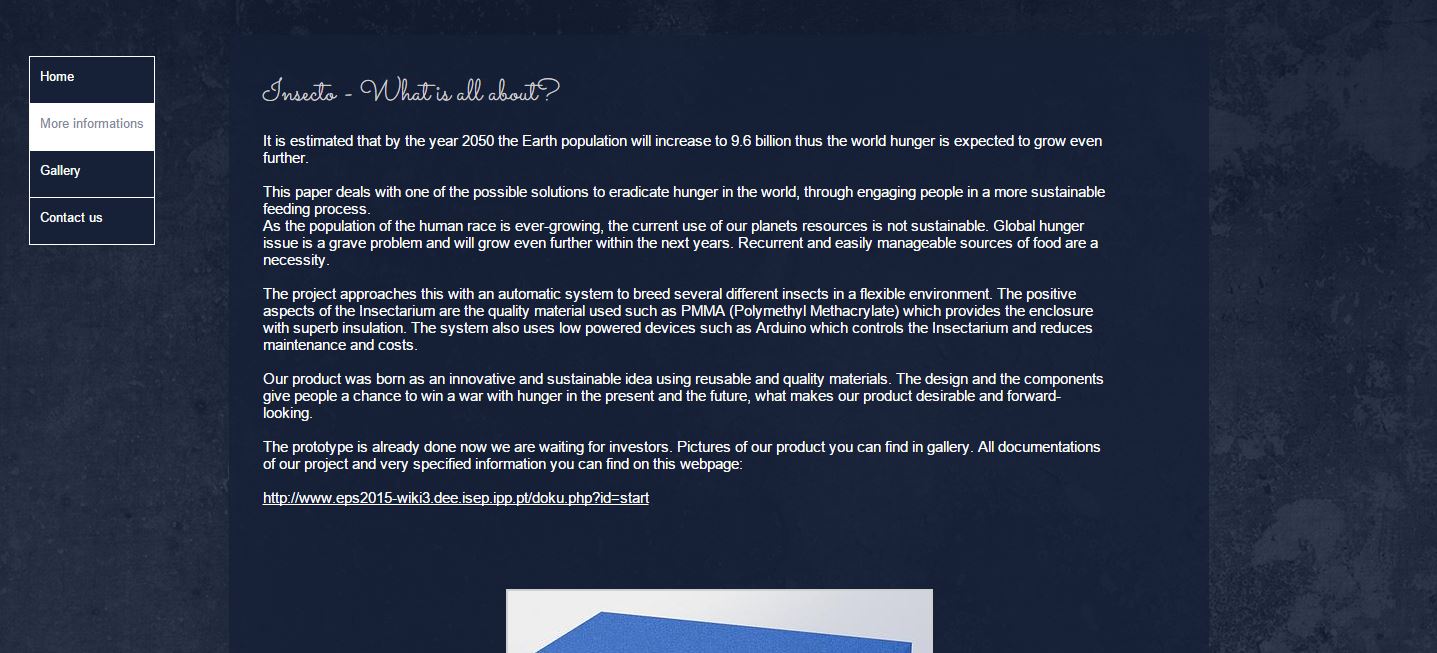 Figure 4.11: Screenshot of insectarium webpage - second page
To visit our page: http://bqraaa.wix.com/insecto
4.7.4 Place/ Sales
The market-directed and distribution-logistic activities are content of the distribution policy. Which include e.g. acquisition of new customers, bringing about a transaction as well as the bridging of areal distance.
In our organization we have a kind of intern and extern distribution organs which conduct the distribution activities of the product on the market. The ways how the product reach the customer are the possible both as said above (4.2.1.3.2 customers). Per direct distribution once but also per oblique. Per direct distribution we offer our product for private persons with pets or for little farmers in the internet on a homepage, which is also orderable there. That enables customer contacts but also obligation. Which is turn to a confidencial and the result is loyality.
Per oblique distribution we think of Franchising (a company gets the law to sell the product of another company). We sell our Insectarium to little pet-stores via B2B (Business-to-Business). The advantage for them is on the one hand to feed their pets healthier and cheaper, on the other hand they have the chance on profit by selling our product more expensive. So they will be motivated to be our customer. On the one hand we have a control about the distribution activities and an immediate communication to ultimate buyer. But on the other hand we coincident have the chance for a high-volume-distribution. Another point is the kind of contact to customers. Everything is possible: direct, personal and impersonal by fairs, telephone or mailing.
Because of the fact that we are not bound on any suppliers and do not have any stocks, we have not think about a fixed location for our disposal. It is possible to purchase the needed materials in an acceptable time from everywhere in Europe, because of the good transmission inside. Just for the future we have to think about the time, when the orders increase. For the beginning we start in Portugal of course because of the project and the support. But the target market is also the whole Europe because insects are more used as animal food, but secondly for humans as well. The support of the government could be high because they are for green project, also with a look in the future. For transporting the commodity trucks or normal post cars are an option dependent on the amount for little money.
4.8 Budget
Referring to the topics above that mentioned some approaches cost money. For our project we have a marketing budget of about 5000€ for the first year and for the start up. That means that we have to be very careful and it has to be considered which points are the most important and for which we should use the money for getting the highest profit out of it and reach the break-even-point as fast as possible. In the following we mention these factors.
For the first year to bring our product on the market and make it interesting we need:
• Collaterals (leaflets, posters, equipment for a stand, insects, design inside the Insectarium) ca. 600€ [(Print Banners24. (n.d.). Retrieved April 21,2015,from http://www.printbanner24.de/calculator.php)]
• Trade fairs ca. 200€/trade fair, referring to the country, we expect of 3 trade fairs ⇒ 3 x 200€ = 600€
• Selling events free or round about 100€, the same like above, also three times ⇒ 3 x 100€ = 300€
• Travel (flights, car or taxi) ca. 1000€
• Website for free for the first time but later 25€/month, so 300€ [(Weebly is the easiest way to create a website, store or blog. (n.d.). Retrieved April 21, 2015, from http://www.weebly.com/free-trial/index.php?c=mkt_w_nwk:Affiliate_cat:NaturaInt_type:top10_camp:NI-INTL_ag:2-3_subid:V13-20249001Pb&lang=de)]
• Deportation and packings ca. 500€ + 50€ = 550€ [((n.d.). Retrieved April 21, 2015, from https://www.ratioform.de/webshop/business.exe/pw=sm/vs=de/key=0d1de5eb738f9b20b671a5f9ccf78b7326d800d301O03/center/search/main.ipm?search=quick&init=0&ff_filter_group_world_key=280132&ff_filter_group_category_key=280632&button_generic=search&url_stack_id_)]
Summarized we have costs of about 3,350.00€. The costs for the building take the ISEP University.
We should consider that this is the highes number of money. Because we have many chances to get some supports or cooperations that reduce the costs. Because of the team which consists of 6 members from different countries we can also save travel costs when we make promotion locally.
4.9 Strategy Control
Regarding to our consumption above, which is also the planning of the marketing strategy and approach, it is impossible to manage without controlling these fields. Controlling is for reducing or purging mistakes of the planning. It has to comprise the whole process. How we can control our approach? First it is important to define all points of the marketing, which are: marketing analyses, SWOT analysis, objectives, segmentation, strategy, marketing mix and budget. After that we have something to control.
Table 4.8: marketing controls
| control of the product-market-relationships | control of the marketing-organisation-units | control of the marketing-measures |
|---|---|---|
| products or product types | product management, key account management | promotion units or other kind of communication |
| customers or customer groups | vending-offices | asking price |
| task, disposal, sales | service department | changing of a product design |
Regarding to table 8 and 9 it is relevant to compare the desired condition with the actual condition. When we realize that we have deviations in the comparison it is important to analyze the causes that exacerbate our achieving objectives. Important is an improvement of the contentual work and also of the planning procedure. Controls could be result-oriented or process oriented. The second one means to revise, if tasks were realized, timeplans were adhered to, information obligation were flewed, concept prepared and the decisions were made [( I. Gegenstand, Bedeutung und System der Marketing-Planung und -Kontrolle. (n.d.). Retrieved April 24, 2015, from http://www.daswirtschaftslexikon.com/d/marketing_planung_und_kontrolle/marketing_planung_und_kontrolle.htm)].
Our situation could become like this:
Table 4.9: What is especially to control regarding to our project
| What do we want to reach? | a renatble product that gives profit | is liked by customers | get some cooperations or supports | farmers buy because of healthier food | stay sustainable | |
|---|---|---|---|---|---|---|
| What happens? | no profit | customers do not like | no one is interested | stay with the old food as feed | the materials or devices always get broken | |
| Deviation towards the plan and why? | no cover of the costs because no buyers for the product | do not like the design | not enough promotion | are not motivated to change everything because they do not see the profit for themselves | bad material or bad construction | |
| What should be done as a correction? | offer the product in other countries as another usage | change the design and dimensions | more aimed promotion | show them the better feeding by testing for few month or like a leasing | revise the construction and search for better suppliers | |
4.10 Conclusion
In summing up we realize that we have a high chance to come into the market. We have our mission, the tasks for each of us are clear. Furthermore we have strategic objectives on which we have to take an eye and which we follow. The strategic situation analysis is done so we can assess the market and can react. Because of our SWOT analysis we are able to estimate each of our situation. And in the case that something runs wrong we have a controlling which shows us the mistakes and shows the possibilities for solving the situation.
Because of the young development of Insectariums in the market are two possibilities which can join us in the future: first, we become a “poor dog” ( low market share, low growth, self-retaining but without future). This could happen when nobody is interested in our product. Otherwise we become a “star” ( high market share, high growth, high profit), this is joining, if everything run like we planned: good planning, right implementation, exact control and that the product is liked.
The next chapter shows you one strength of the product. It shows how sustainable we really are and why.
5 Eco-eficiency Measures for Sustainability
5.1 Introduction
There is no universally agreed definition on what sustainability means. There are many different views on what it is and how it can be achieved. for us and our company , sustainability is :
A process of change in which the exploitation of resources, the direction of investments, the orientation of technological development and institutional change are all in harmony and enhance both current and future potential to meet human needs and aspirations.
The environment must be protected. to preserve essential ecosystem functions and to provide for the wellbeing of future generations; environmental and economic policy must be integrated; the goal of policy should be an improvement in the overall quality of life, not just income growth; poverty must be ended and resources distributed more equally; and all sections of society must be involved in decision making.
5.2 Environmental
The insectarium allows you to grow more food per square kilometre which helps the environment because the human population is growing which makes land more valuable.
The insectarium uses an environmentally friendly plastic called PMMA which has a long life cycle , can be used many times ,it is 20 times stronger and half as light. The maintainence of the insects is little since it is automatic.The PMMA also has good insulation to allow the insects to remain at comfortable temperature.
It is user friendly since it has an LCD backshield with keyboard which allows the user to set the temperature range that he wants the insects to live in.The system uses low powered electrical programmes and devices to allow the insectarium to be environmentally friendly and cheap.
5.3 Economical
The insectarium is a very good choice economically since it is sustainable using low powered electrical devices and programmes for the automatic control to minmise use of power as much as possible.
The insectarium offers customers an opportunity to grow insects with a high protein content in a small space which offers people an alternative method to having protein than eating fish and meat which are a expensive option. The insectarium is also targeted to zoos and farms in order to feed the animals which shows it offers flexibility in the market and great potential.
Figure 5.1: Feeding amount with insects
This chart shows how the same amount of 10 kg will feed a cow which will produce 1kg of meat and insects once fed the same amount of food will produce 9 kg of meat, this is nine times the amount of a cow which shows that insects are a very good option economically since they require little food and produce alot of meat.
Our insectarium is under 100€ which means it offers customers in zoos and farms for example a cheap price with a well designed automatic enclosure with low maintenance.
5.4 Social
SUPPLIERS:
Sustainability in supplier management is of high importance to Insecto. When making procurement decisions, we do not only take into consideration economic, technological and process criteria. In line with our Group’s mission statement and policies, we also place highest value on social and ecological aspects such as the protection of human rights, the fight against corruption, and protecting the environment.
We want to eliminate the risk of having who do not live up to basic human rights. That is why we have meetings with the suppliers where we talk about safety, privacy, respect the working hours and no kids working in those factories.
EMPLOYEES:
Being part of something meaningful is really cool.Every employee is looking to feel good about where they work and make a larger contribution. Through sustainability they can feel better about their role within a company.
And those feelings matter to our company’s bottom line. Employees who are the most committed to their jobs put in 57% more effort on the job and are 87% less likely to resign, according to a study conducted by the Corporate Executive Board [(The End of Solution SalesCustomers don't need salespeople – so sales leaders need a new playbook. Download the ArticleFeatured in Harvard Business Review Score Your Pre-Sales ActivitiesIn creating customer demand. (n.d.). Retrieved March 16, 2015, from http://www.executiveboard.com/exbd/sales-service/the-end-of-solution-sales/index.page)].
Give equal opportunities to both men and women, not depending on gender even if depending on capacity and ability. Our company values families, that is why we aim to make our employees schedules as flexible as possible. Make our employees feel appreciated and valuable, having the opportunity to communicate their ideas to the team and taking part in the company decisions. Provide health and safety training and ergonomically designed workstations to reduce health-related risks and costs.
PRODUCERS:
we want to avoid as much as we can the labor accidents. What we do is to give them courses once a year about accidents that appear while using a machine. We also give them specific training about the new equipment that arrive to the factory. Insecto makes a difference to small farmers and workers. By targeting their income, living, and working conditions, the company aim at the improvement of farmers’ and workers’ socio-economic situation:
• Minimum price and access to pre-financing
• Improvement of livelihoods and protection against price fluctuations
• Minimum price paid on the top that benefits not only individual farmers, but also their communities
• Help women to realize their full potential and to get the respect in their communities that they deserve
• Use of environmental friendly production methods
• Preservation of traditional farming and agro-ecological practices
DISTRIBUTORS:
Here we are going to talk about logistic. Logistic is the management of the flow of goods between the point of origin and the point of consumption in order to meet some requirements of customers.
The product distribution is an important part of the product cycle because we have to make sure that it is properly and safely. Likewise, we consider employees who carry out these deliveries, taking care of their safety and their physical and mental skills required for the job
• Before and after the transportation: We want to eliminate the risks that came from the delivers, like accidents in the road. That is why we are always making revisions to our trucks and making courses to our employees about the risk on the road and sensitization about accidents.
• During the transportation: handling conditions must be suitable for our employees. They are not going to load more than the recommended weight ( 20 kg ) and in case of having to carry more weight, they are going to use machines suitable for this purpose.
• We want to give courses to our drivers about how to drive in an ecological and sustainable way, trying to reduce the CO2 and using less fuel oil.
CUSTOMERS:
Food is essential to life. It also forms an important part of our cultural identity, and plays an important role in the economy. People are aware that the food they eat is an important factor affecting their health aswel as the health for their animals, but what is less well known is the impact producing and consuming food has on the world's resources.
That is why:
We are using materials little dangerous for our clients healthy. We are also giving to our customers a leaflet with the instructions of the insectarium: what to do before, during and after having the insectarium working. We would like to know what problems they have with the insectarium, that is why we are giving them a free telephone number for those incidents. At the time we receive that incident, we study the problem and we register it to avoid similar problems in the future. The food that our insectarium produces is healthy for the animals as well as for humans, because it has a high level of proteins and it is produced without any chemicals compared to the food that we know today.
5.4 Life Cycle Analysis
Life Cycle Assessment (LCA) is a technique for assessing the potential environmental aspects and potential aspects associated with a product (or service), by:
• Compiling an inventory of relevant inputs and outputs
• Evaluating the potential environmental impacts associated with those inputs and outputs
• Interpreting the results of the inventory and impact phases in relation to the objectives of the study[((n.d). Retrieved March 23, 2015 from http://www.gdrc.org/uem/lca/lca-define.html)]

Figure 5.2: Life-Cycle assessment
Insecto aims to keep our products environmental impact as low as possible in each stage of its life-cycle. Since our company cares about the sustainability of our planet we aim to show a good example to the other companies and consumers in every stage of our products life cycle.
Raw material procurement
The plastics and the electronic components that we chose for the insectarium are high quality, responsibly manufactured, cost-effective and easily recycleable - our suppliers have ISO certificates to prove that. The electronic components have a low energy consumption, which we achieve by testing different types of energy sources.
The electronic components have a low energy consumption, which we achieve by testing different types of energy sources.
For building the carcass of the insectarium we use PMMA- because it has very good temperature and sound isolation, material is very durable and has a long life-cycle also it is very light.
The glue we use has a long life-cycle and is very strong, it is durable to different enviromental conditions.
For the electronics part we chose an LCD Shield with a keypad, which is easy to use, is sustainable and cheap.
12 V DC cooling fan is cheap, sustainable, efficient and can be compatable with Arduino.
Temperature and humidity sensor chosen by us– is compatable with Arduino, sustainable, efficient and is cheap.
Manufacturing
In the manufacturing stage we aim to conserve as much material as we can so every plastic that we use will either be used or sent to a recycling facility, we make a lot of investments for material research and take precautions to minimize the water, air and ground water pollution. Our factory tries to lower its energy consumption when possible, in the production area and the workers area, through well taught employees.
• New products and manufacturing approaches that reduce demand for scarce resources while enabling sustainable growth
• Driving development of cost-effective renawable and alternative energy sources like solar and wind power
• Utilizing technologies that re-use rather than waste energy in automation systems
• Analyzing and re-engineering production systems to eliminate wasted motion,materials and energy consumption
• Implementing strategies such as lean manufacturing to drive out waste across al areas of production
[(Recyclable Planet. (n.d.). Retrieved March 16, 2015, from http://www.recyclableplanet.com/smanufacturing.php)]
Distribution
The insectarium will be distributed to different parts of the planet according to a thorough research, more will be shipped to the places of higher demand. Transportation is always used according to the customers needs, trucks fueled by biodiesel and ships are the main focus. Packaging choices are made keeping in mind the specifics of transportation but always using as few material as possible(for example packaging of the insectarium has no excess space in it).
Consumer use
The product needs little maintenance due to the simplicity of it. The consumer itselfs becomes more sustainable just by using the insectarium . Why is that ?
• The product launched includes some electronic gadgets which consume as little energy as possible.
• Food reproduces it by itself in the insectarium without needing extras.
• Waste food like carrots,apples,meal can be used as food for the insects.
• Healthy food for animals aswel as for the animals:
- They’re environmentally friendly. A mealworm farm takes up zero useful land. Mealworms can even be grown in a closet or under a bed.
- They’re a good source of protein. Mealworms contain about 25% protein, and 12% fat 21).
- They’re tasty! When toasted in the oven, mealworms taste just like roasted nuts or seeds. They’re particularly good covered in chocolate or sprinkled on soup [(Code of Ethics. (n.d.). Retrieved March 18, 2015, from http://www.nspe.org/resources/ethics/code-ethics)].
End of Life
Our Insectarium has many components, that are durable, so there is no need to renew it every few years because the materials live long for just a bit more money. In case of recycling the product, it is possible to use all technical gadgets for other things further. The components of the livingroom of the insects are also ecological. The bread crumbs, some ecofriendly board and wood, more is not needed. For the building of the insectarium we have long living pmma plastic and steel mesh. Of course, this are our only components that are recyclable and are no trash that produce chemicals when that become recycled. But it must not come to this, because of the good quality of the plastic, one can also use it again. The same with the steel mesh, if it is needed for other things where you can insert it. But that all only happen, if the customer or the user do not want to have insectarium anymore or do not want to sell it further or use it for other animals. Because from alone it does not become destroyed.
5.4 Conclusion
Insecto is a product that provides sustainable food for now but more important , for the future. We aims to be sustainable as possible for our earth and be innovative compared to other insectarium products.
6. Ethical and Deontological Concerns
6.1 Introduction
In this chapter we will develop ethical and professional standards of our company.
In everyday life people should always pay heed to ethical way of behaviour. Being human implies following some moral rules which can be considered in different aspects. For instance, teachers should comply with a particular set of rules regarding acting against their pupils, pupil's parents etc.; companies workers should behave in a moral way towards their co-workers, clients, and superiors; engineers should always care about their products’ safety. In our project we could consider ethics and deontology in all its bearings, yet we divided our analysis only into five main aspects which are especially related to our work. These are the following:
• Engineering ethics issue.
• Sales and marketing ethics issue.
• Academic ethics issue.
• Environmental ethics issue.
• Liability issue.
During the design of the product, the construction or the selling, there will be a lot of conflicts that can be very complicated to find the right solution. That is why we should put some rules before starting all the process.
6.2 Engineering Ethics
The decisions and actions of the engineers have a great impact on the environment and in society. The engineering profession has, therefore, the obligation to ensure that their decisions are consistent with the public interest and in all matters relating to safety, health and sustainability.
That is why we have used the Nacional Society of Professional Engineers [(http://www.nspe.org/resources/ethics/code-ethics)]. This code of conduct contains the following principles:
• The engineer has a personal obligation to act with integrity in the public interest and applying all the experience and knowledge necessary for theoretical and practical perform their work.
• In their works, the engineers :
- maintain their core competencies to the necessary level and only assume those jobs for which they are adequately trained
- Will not lead to misunderstandings in their academic qualifications or in their Professional titles.
- they issued impartial analysis and findings with their employers or their clients, avoiding conflicts of interest, and observe properly the duties of confidentiality
- conduct their work properly thus preventing avoidable dangers safety and health as adverse impacts on the environment
Engineers can rely on the Engineering code of ethics to make the right decisions. Engineering ethics, internationally, comprise of three basic core aspects: Competence, Integrity and Sustainability.
23)[((n.d.). Retrieved March 22, 2015, from http://deres.org.uy/wp-content/uploads/Manual-de-Etica-DERES.pdf)]
6.2.1 Competence
Engineers shall perform services only in the areas of their competence.
• Engineers shall undertake assignments only when qualified by education or experience in the specific technical fields involved
• Engineers shall not affix their signatures to any plans or documents dealing with subject matter in which they lack competence, nor to any plan or document not prepared under their direction and control
• Engineers may accept assignments and assume responsibility for coordination of an entire project and sign and seal the engineering documents for the entire project, provided that each technical segment is signed and sealed only by the qualified engineers who prepared the segment
25)[(Engineering Creeds, Oaths, and Pledges. (n.d.). Retrieved March 24, 2015, from http://www.onlineethics.org/Resources/ethcodes/Pledges.aspx)]
6.2.2 Integrity
Engineers shall be guided in all their relations by the highest standards of honesty and integrity.
• Engineers shall acknowledge their errors and shall not distort or alter the facts
• Engineers shall advise their clients or employers when they believe a project will not be successful
• Engineers shall not accept outside employment to the detriment of their regular work or interest. Before accepting any outside engineering employment, they will notify their employers
• Engineers shall not attempt to attract an engineer from another employer by false or misleading pretenses
• Engineers shall not promote their own interest at the expense of the dignity and integrity of the profession
• Engineers shall give credit for engineering work to those to whom credit is due, and will recognize the proprietary interests of others
• Engineers shall accept personal responsibility for their professional activities, provided, however, that engineers may seek indemnification for services arising out of their practice for other than gross negligence, where the engineer's interests cannot otherwise be protected
• Engineers shall not attempt to injure, maliciously or falsely, directly or indirectly, the professional reputation, prospects, practice, or employment of other engineers. Engineers who believe others are guilty of unethical or illegal practice shall present such information to the proper authority for action
• Engineers shall not attempt to obtain employment or advancement or professional engagements by untruthfully criticizing other engineers, or by other improper or questionable methods
[(Ethical Practices in Sales & Marketing. (n.d.). Retrieved March 24, 2015, from http://smallbusiness.chron.com/ethical-practices-sales-marketing-64319.html)]
6.2.3 Sustainability
Sustainability ethics is concerned with the moral aspects of the threefold relationship of humans with other contemporaries, future generations, and nature. It simultaneously analyses the moral aspects of this threefold relationship. + Engineers are encouraged to adhere to the principles of sustainable development in order to protect the environment for future generations.
That is why during preparation and reasarching we were supposed to take care of all these aspects and we surely can say that that any other contemporaries, future generations, and nature will not be hurt. We are not going to use any nonrenewable resources that are going to run out in future and moreover it is worth to notice that most of them are recyclable. Materials are not toxic, mealworms and user-friendly so they will grown in good an healty conditions which not influence on worms taste. It assures good quality of them. Our product can face with opponents of meat eating but as long as it is used to grown insects and as long as our company is focus mainly on provide insects for animals it should not be a big problems because we did a reasearch and a lot of vegans and vegetarians agreed that eating insects is fine. We also take care of health and safety aspects of workers.
6.3 Sales and Marketing Ethics
Our sales and marketing activities have to follow ethical standards if we hope to avoid sanctions from regulatory agencies and loss of reputation with customers. Ethical companies know how to respect the rights of all stakeholders in the business while making decisions that are in the interests of the company.
• Marketing communication should not contain statements or visuals that offend standards of decency.
• Relevant factors likely to affect a customer’s decisions should be communicated in a way and time so they can be taken into account.
• Marketing communication should not play on fear or exploit misfortune.
• Marketing communication should not appear to condone unlawful behavior.
• Marketing communication should be truthful and not by implication, omission, ambiguity or exaggeration mislead the customer.
• Marketing should not misuse research results or quotations of individuals.
• Marketing claims made about a location should be capable of substantiation and that evidence should be available so it can be provided to any organization responsible for regulation of ethics of the profession.
• When an advertisement appears in a medium containing news or editorial matter, it should be recognizable as an advertisement and the identity of the advertiser should be identifiable. Where appropriate, it should contain contact information to enable the customer to contact the advertiser.
• Marketing communication that contains comparisons should comply with the principles of fair competition and be based on facts that can be substantiated and not unfairly selected.
• Marketing communication should not denigrate any person, group of persons, organization or community.
• Marketing should not contain any testimonial or endorsement unless it is genuine, verifiable and relevant.
• Marketing communication should not imitate those of another marketer in any way likely to mislead or confuse the customer.
• Those who collect data in connection with marketing communication activity should have a written privacy policy that is readily available to customers.
• In any communication channel (including social media), if an opinion is put forward that could lead to an action that financially benefits the author (or employer), it should include a full disclosure statement.
6.3.1 Professional conduct
Ethical conduct in sales and marketing means using a professional approach to customers, competitors, members of regulatory bodies and company colleagues. Characteristics of such conduct include respectful interactions, consideration for cultural diversity and nondiscriminatory behavior toward people who are different than us. We have to behave honestly, portray situations and products accurately and make constructive contributions to discussions about problems and solutions, and you must observe the applicable laws and regulations at all times and adhere to company ethics policies.
We can say that professional conduct is:
• Place the integrity of the profession and the interests of clients above your own interests.
• Act with integrity, competence, and respect.
• Mantain and develop our professional competence.
• Professionalism and integrity.
• Duties to clients and employers [(]Sales & Marketing Creed: The International Code of Ethics for Sales and Marketing. (n.d.). Retrieved February 21, 2015, from https://www.smei.org/?16)]
6.3.2 Competition
Healthy competition delivers value to customers while allowing companies that compete to earn an appropriate return on their investment. Ethical behavior in a competitive environment includes supporting fair competition, competing on the basis of accurately representing your products and services in the marketplace and fulfilling your obligations in good faith.
6.3.3 Pricing
Following ethical guidelines in pricing means prices have to be clear without hidden charges. The consumer has to know how much he is going to pay when he makes the purchase. Your prices have to reflect both the cost you incur in delivering the product or service and the value the customer expects to receive [((n.d.). Retrieved February 28, 2015, from http://study.com/academy/lesson/environmental-ethics-human-values-definition-impact-on-environmental-problems.html)].
6.3.4 Products
Ethical sales and marketing offer only safe products that are suitable for their intended use. Supply of the product includes supplying instructions that the customer can follow to make the product work as intended, providing customer service to resolve problems and dealing with problems objectively by applying appropriate solutions. Following these ethical guidelines is good business practice because it increases customer satisfaction.
6.3.5 Research
Businesses obtain personal information about their customers during sales activity and marketing research. Ethical practice means you respect the privacy of customers and safeguard their data. You have to follow privacy legislation and inform customers that you are collecting their data, let them know its intended use, use the data only for that purpose and destroy it securely when you no longer need it.
• Discuss intellectual property frankly Academe's competitive “publish-or-perish” mindset can be a recipe for trouble when it comes to who gets credit for authorship. The best way to avoid disagreements about who should get credit and in what order is to talk about these issues at the beginning of a working relationship, even though many people often feel uncomfortable about such topics.
• Be conscious of multiple roles APA's Ethics Code says psychologists should avoid relationships that could reasonably impair their professional performance or could exploit or harm others. But it also notes that many kinds of multiple relationships aren't unethical–as long as they're not reasonably expected to have adverse effects.
• Follow informed-consent rules When done properly, the consent process ensures that individuals are voluntarily participating in the research with full knowledge of relevant risks and benefits.
• Respect confidentiality and privacy Upholding individuals' rights to confidentiality and privacy is a central tenet of every psychologist's work.
• Tap into ethics resources One of the best ways researchers can avoid and resolve ethical dilemmas is to know both what their ethical obligations are and what resources are available to them.
6.3.6 Promotion
Sales and marketing include promoting your products and services to potential customers. Ethical promotion portrays your offers honestly and accurately, without links to attractive lifestyles that are not relevant. You have to promote your products and services on their own merits and highlight those features that members of a target market might find valuable when promoting to that market segment.
• Marketing communication should not contain statements or visuals that offend standards of decency.
• Relevant factors likely to affect a customer’s decisions should be communicated in a way and time so they can be taken into account.
• Marketing communication should not play on fear or exploit misfortune.
• Marketing communication should not appear to condone unlawful behavior.
• Marketing communication should be truthful and not by implication, omission, ambiguity or exaggeration mislead the customer.
• Marketing should not misuse research results or quotations of individuals.
• Marketing claims made about a location should be capable of substantiation and that evidence should be available so it can be provided to any organization responsible for regulation of ethics of the profession.
• When an advertisement appears in a medium containing news or editorial matter, it should be recognizable as an advertisement and the identity of the advertiser should be identifiable. Where appropriate, it should contain contact information to enable the customer to contact the advertiser.
• Marketing communication that contains comparisons should comply with the principles of fair competition and be based on facts that can be substantiated and not unfairly selected.
• Marketing communication should not denigrate any person, group of persons, organization or community.
• Marketing should not contain any testimonial or endorsement unless it is genuine, verifiable and relevant.
• Marketing communication should not imitate those of another marketer in any way likely to mislead or confuse the customer.
• Those who collect data in connection with marketing communication activity should have a written privacy policy that is readily available to customers.
• In any communication channel (including social media), if an opinion is put forward that could lead to an action that financially benefits the author (or employer), it should include a full disclosure statement.
6.4 Academic Ethics
The academic ethics is similar to the previously explained ethics as its main asset is the integrity of the person. We have chosen as the script conducted by the University of Northern Iowa [(http://www.uni.edu/)] and have found this scheme:
6.4.1 Plagiarism
Plagiarism is intentionally or unintentionally using someone else’s words or thoughts, without giving proper credit.
• Substantial copying without credit
• The copying is done fraudulently
• The intention is clearly to fool the reader
• It has a potential negative repercussion for the reader and/or original author
So we educate all the team-members how to avoid plagiarism like the examples mentioned here above.
6.4.2 Misrepresentation
Misrepresentation is a false statement of fact
6.4.3 Fabrication
Fabrication means falsifying or misusing data in any academic exercise.
6.4.4 Cheating
Cheating is attempting to present as one’s own, work that one has not performed, or using improper means to pass an examination
6.4.5 Facilitation
Facilitation occurs when you knowingly or intentionally assist another in committing a violation of any of the previous sections of this academic ethics policy.
We, as a company, must work on avoid this situations to make our customers feel 100% confidence in our product.
6.5 Environmental Ethics
Environmental ethics is the philosophical discipline that considers the moral and ethical relationship of human beings to the environment. In other words: what, if any, moral obligation does men have to the preservation and care of the non-human world? While ethical issues concerning the environment have been debated for centuries, environmental ethics did not emerge as a philosophical discipline until the 1970s. Its emergence was the result of increased awareness of how the rapidly growing world population was impacting the environment as well as the environmental consequences that came with the growing use of pesticides, technology, and industry. That is why our company is committed to:
• Use low levels of pollutants to the environment, to insects and customers
• Use readily recyclable materials
• Create a product in which the different materials used are easily separated by category (glass, plastic , cardboard ) for proper recycling
• Make a recyclable packaging for transporting using the right amount of material
6.6 Liability
Businesses are usually liable for defective products, negligence and breaches of warranty. These are all examples of tort liabilities. A business is liable if their product injures someone physically or emotionally. Businesses are also liable for injuries that happen on their property and any damages that occur as a result of actions taken on behalf of the business. There is a specific type of product liability know as strict liability, which describes who (among manufactures, contractors, suppliers and retailers) is specifically responsible in the cases of defective products.
In insecto we have three party in the liability section we have to think about such as:
- Legal liability
we are committed to create such a product which will obey some legal rules, e.g. EU directives such as:
1. Machine Directive (2006/42/CE 2006-05-17);
more info –> http://ec.europa.eu/enterprise/sectors/mechanical/documents/legislation/machinery/index_en.htm
2. Electrical Safety: Low Level Voltage Directive (2006/95/CE 2006-12-12);
more info –> http://ec.europa.eu/enterprise/sectors/electrical/lvd/index_en.htm
3. Restriction of Hazardous Substances (ROHS) in Electrical and Electronic Equipment Directive (2002/95/EC 2003-01-27);
more info –> http://ec.europa.eu/environment/waste/rohs_eee/legis_en.htm
- Criminal liability
The liability that arises out of breaking a law or committing a criminal act. Liability insurance does not cover criminal liability.
So we make sure that we make and sell the insectarium according to the laws , so that nothing is done illegal
Read more: http://www.businessdictionary.com/definition/criminal-liability.html#ixzz3XOMdyv46
- Professional liability
in this case, following the engineering code of ethics is highly preferable.
6.7 Conclusion
We have to understand ethics as a part of the integrity of the person. All aspects of our life, both work and personal, are governed by a code of ethics. Therefore, our insectarium project must have ethical standards : the design will try to be as sustainable as possible and use materials less contaminating; in the phase of marketing a real product will be sold without handling any kind of product characteristics ; and finally , it must be the author's own work , not plagiarized.
7 Project Development
7.1 Introduction
After the project was chosen, our project development started, we began by conducting research through state-of-the-art studies, the development of a suitable architecture for the insectarium will be presented in the following. Afterwards Based on the knowledge obtained we agreed on the design and could finally make the list of materials.the prototype´s required components, electronic functionalities and implementation processes will be explained and experimentally evaluated.
7.2 Architecture
First we made some sketches with different ideas of how the insectarium should look like.


Figure 7.1 - 7.4: Sketches of ideas
We made a brainstorming about how our Insectarium should look like and made differents 3D designs.


Figure 7.5 - 7.8: Sketches about the first 3D ideas of the Insectarium
Afterwards we decided how our insectarium should look like according to our deliverables (leafleft, presentation, poster) and we choose the colors


Figure 7.9 - 7.14: Short list of the ideas
After having all the materials that we ordered and a few changes in colors, our insectarium looks like this 3D design


Figure 7.15 - 7.19: solutions for the insectarium with designs
Below you can find the side and the front view of our insectarium


Figure 7.20 - 7.24: side and front view of our insectarium
We decided to make a simple shape for the insectarium because one of our future goals is to be able to stack some of them for a bigger production. Another reason why we decide it is because our client asks for a user-friendly insectarium, easy to use and trying to exploit much space as we can, using less material.
First of all we have to decide what type of plastic we are going to use, and that is why we made a comparison between the most used plastics in construction.
Table 7.1: Types of plastic
| PLASTIC | NAME | DENSITY (g/cm3) | TEMPERATURE (ºC) | TRANSPARENCY (%) | STRENGTH |
|---|---|---|---|---|---|
| HDPE | HIGH-DENSITY POLYETHYLENE | 0.93-0.97 | 120 | Opaque | Strong intermolecular force |
| UHMW-PE | ULTRA HIGH MOLECULAR-WEIGHT POLYETHYLENE | 0.945 | 136 | 39-75 | Really strong intermolecular force |
| PP | POLYPROPYLENE | 0.90-0.91 | 100 | 70-85 | Normally tough |
| PVC | POLYVINYL CHLORIDE | 1.40 | 80 | 80-85 | Normally tough |
| POM | POLYOXYMETHYLENE | 1.41-1.42 | 115 | 75-85 | High |
| PMMA | POLYMETHYL METHACRYLATE | 1.19 | 160 | 93 | High (20 times stronger than glass) |
After having all that information, we choose the PVC and PMMA because of its good properties.
We decided to use PVC in those parts of our Insectarium where we don't need a transparent piece, due to its good resistance and because of it is easy to work with.
We are also using transparent PMMA in the front part of our Insectarium for letting the client to see the insects and how the life-cycle is going on without opening the top of it.
As our product is adaptable to the client’s necessities, if one of them doesn’t want to see what is inside of it, he can ask for an opaque wall and check it opening the top.
•
HOW TO USE THE INSECTARIUM
The first thing we have to do is to choose the insects we want to place inside our insectarium. Our project was focus on mealworms, so our temperature range is between 25°C and 30°C.
After deciding it and unpackaging our insectarium, we have to plug it into the wall.
Once the temperature ranges have been chosen it allows the insectarium to automatically control the insectarium and its insects in the chosen environment. The heater and cooling fan placed in the enclosure will activate if it is too cold or to warm (out of range) to allow it to stay at a fairly constant and steady temperature.
The LCD will display temperature and humidity in 4 digits each ( 2 decimal places ).
How to select temperature range with LCD Keypad shield.
Step 1: Select temperature range hold the select button until main menu screen appear.
Step 2: Then either:
- Press up and select to change maximum temperature.
- Press down and select to change minimum temperature.
Then use the 2 middle buttons to increase/decrease the numbers to the chosen temperature range you want for both minimum and maximum temperature.
The LCD and arduino will now work on this range and if the enclosure is out of this temperature range then the heater / cooling fan will activate.
The 12 V cooling fan will help reduce the temperature if the insectarium is out of the temperature range and mix air in the insectarium.
The heater will activate when the temperature is out of range (too cold) in the enclosure.
After having the electronic components working, we are allowed to place the insects inside of our insectarium.
The insectarium is divided in two different parts:
• The main part, where the insects (eggs, mealworms and bugs) are going to live. This main part has a heater and a fan to adjust the temperature inside.
• The second part is the drawer.
We have to fill the insectarium in the main part with sand and insects until the estimated line (no more than 10 dm2).
The main part and the drawer are going to be separated by the layer, and when we remove it, the mealworms and the bugs are going to stay in the net that is placed between the layer and the drawer, and the eggs with the sand are going to fall down into the drawer.
When the insects are separated, we can remove the mealworms for consumption.
After removing them, we put the layer again in the insectarium and put out the drawer with the eggs and the sand for the next life cycle.
7.3 Components
Electronic schematics
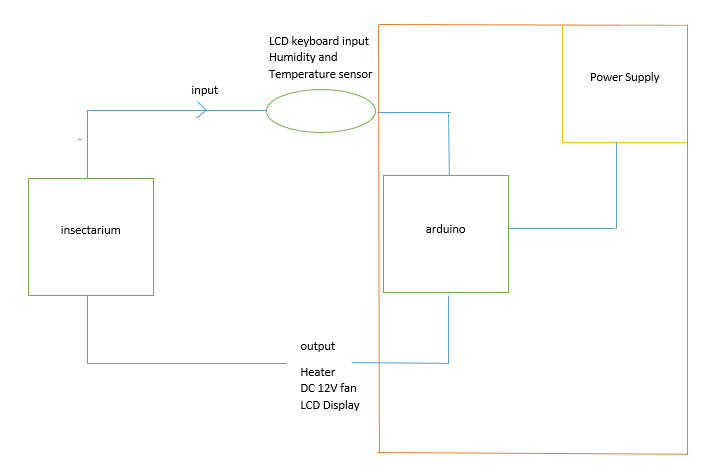
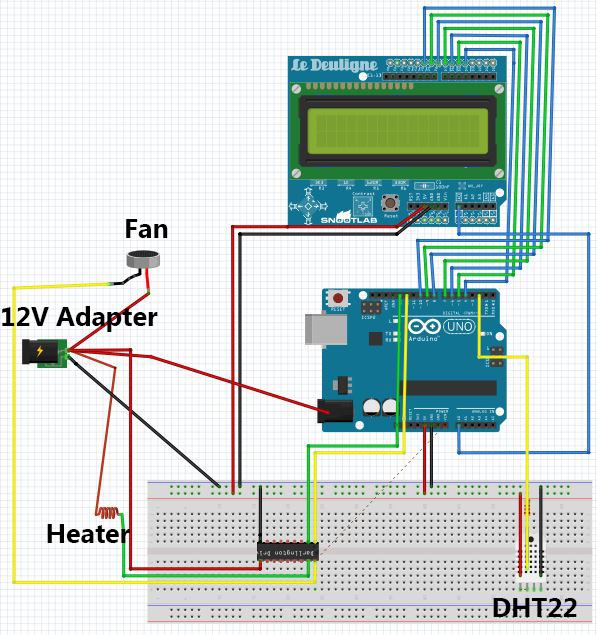
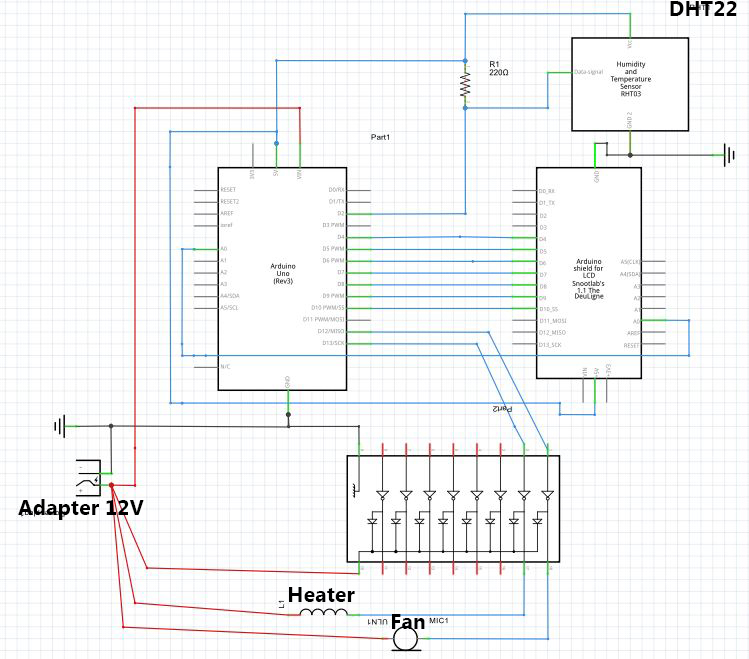
Figure 7.25 - 7.27: Electronic schematics
Microcontroller
Table 7.2: Microcontroller 21)
| Microcontroller | Voltage input (V) | Voltage output (V) | Easy of use | Power consumption (W) | Price to needs | Dimensions (mm) | CPU Frequency (MHz) | Additionals req. | Price (€) |
|---|---|---|---|---|---|---|---|---|---|
| Arduino Micro | 7-12 | 5 | Easy | Small | Good | 48 x 18 | 16 | USB Converter | 23.37 |
| PLC | 12-24 | - | Hard | Big | Bad | 2 x 80 x 94 | - | Expensive Software | 280.00 |
| Raspberry PI | 5 | 5 | Average | Very Small | Average | 85.60 x 56 x 21 | 700 | SD Card | 43 |
| Arduino Uno | 7-12 | 3.3 or 5 | Easy | Small | Good | 68.6 x 53.4 | 16 | - | 22.18 |
| Arduino Nano | 7-9 | 5 | Easy | Small | Good | 45 x 18 | 16 | - | 23.99 |
We decided that the best microcontroller to use in our project will be Arduino UNO. It is the cheapest one and fullfil all requirements that we need. It is important that voltage input range is between 7V and 12V because we would like to use 12V adapter to connect fan and heater so we can also connect arduino using this adapter.

Figure 7.28: Arduino Uno
Sensors
Table 7.3: Temperature Sensors
| Temperature sensor | Voltage input (V) | Accuracy (%) | Temp range (°C) | Additional converters | Price (€) |
|---|---|---|---|---|---|
| TMP36 | 2.7 - 5 | 1-2 | -40 to 125 | Resistor | 1,66 |
| LM35DZ | 4-30 | 0.4 | 0 to 100 | Resistor | 2,55 |
| MCP9700A | 2.3 - 5.5 | 4 | -40 to 100 | Resistor | 0,37 |
Table 7.4: Humidity Sensors
| Humidity sensor | Voltage input (V) | Accuracy (%) | Price (€) |
|---|---|---|---|
| HH10D (with EEPROM) | 2.7 - 3.3 | 3 | 11,07 |
| HCZ-J3-B | 1 AC | 5 | 3,64 |
| HIH6030-021-001 | 2.3 - 5.5 | 4.5 | 6,03 |
| HCZ-D5-A | 1 RMS | 5 | 0,84 |
Table 7.5: Humidity + Temperature Sensors
| Temp + Humid sensor | Voltage input (V) | Temp accuracy(°C) | Humid accuracy(%) | Additional converters | Price (€) |
|---|---|---|---|---|---|
| DHT11 | 3.3 - 5 | 1 | 4 | 10 kΩ resistor | 4 |
| RHT03 | 3.3 - 6 | 0.5 | 2 | 10k kΩ resistor | 11,01 |
| DHT22 | 3.3 - 6 | 0.5 | 2 | 10k kΩ resistor | 12,92 |
Our research shows that it is the best to buy one device with temperature and humidity sensor included. If we are buying sensors separately the price is higher and the quality is worse. Because to buy two sensors that are comparable to DHT11 we have to should buy TMP36 (temperature sensor) and HIH6030-021-001 (humidity sensor) and the price is then 7,69 € which is almost two times bigger than DHT11 and accuracy is still slightly worse. That is why we rejected other options and focused on DHT11 or DHT22 which is more expensive but also two times more accurate. Finally we decided that DHT22 has enough accuracy and it is our device to buy.
Displayer and keyboard
We need displayer with keyboard to display Temperature and humidity and set the temperature range inside the insectarium . We considered displayer included keyboard and two separate components to provide the best quality and the best price. We found simple buttons for 0,49euro each. We need at least 5 buttons so the price is equal to 2,45euro.
Table 7.6: Displayer and keyboard
| Displayer + keyboard | Voltage (V) | Quality | Power Consumption (W) | Size | Price (€) |
|---|---|---|---|---|---|
| 7segments (+5x Push Button INM-0711) | - | Bad | Average | - | 1,28+2,45 = 3,73 |
| LCD MC21605A6W-FPTLW (+ 5x Push Button INM-0711) | 5 | Good | Small | 16×2 | 8,81 + 2,45 = 11,26 |
| LCD MC21605B6WD-BNMLW (+ 5x Push Button INM-0711) | 5 | Good | Small | 16×2 | 8,24 + 2,45 = 10,69 |
| LCD Button Shield INM-0700 (with keyboard) | 5 | Good | Small | 16×2 | 15.93 |
| LCD Shield For Arduino INM-0780 (with keyboard) | 5 | Good | Small | 16×2 | 14.50 |
| Itead 1602 LCD Shield (with keyboard) | 5 | Good | Small | 16×2 | 6.7 |
In accordane to our research it is the best option to use Itead 1602 LCD Shield with integrated keyboard, because to size and quality is enough and the price is the best.
Electric Heater
We need an Electric heater in order to heat the room so that if the insect enclosure temperature decreases and goes out of the temperature range that the insects are comfortable with the Electric heater will be activated to increase the temperature. When looking at the electric heaters we considered heat lamps, car heaters and thermal heaters to analyse which heater is the best quality and price for the application.
Table 7.7: Electric Heater
| Electric heater | Voltage (V) | Quality | Power consumption (W) | compatibility | Size | Price (€) |
|---|---|---|---|---|---|---|
| (PTC faceplate heater) | (12-30) | (good) | 20 | good | small | 17 |
| Car mirror heater | 12 | good | 24 | poor | small | 2,29 |
| Heat lamp | 120 | okay | 60 | poor | small | 5 |
| Light bulp | 220 | good | 12 | Small | Average | 10 |
| Infrared light bulp | 220 | average | 12 | small | average | 12 |
| Ni-chrome heating element | 220 | good | 10-1000 | good | small | 5 |
| Toaster heating element | 12V | good | 4.8 | good | average | - |
We had to reject some of the proposals because were not suitable for our project. Light bulb emits light and mealworms don't like light. Infrared light don't heat air, it heats organism which is not the best solution. PTC faceplate heater is quite expensive,and the car mirror heater has too high a current. After some thorough research We believe the best device is a heating element since it is cheap and is flexible since it will allow the user to select which temperature he wants the heating element to be, this device
We looked at heating elements from two different sources (a hair-dryer and a toaster ) and did calculations the following calculations to find the power consumption of each one in the circuit.
Heating element from toaster calculations
Mains voltage = 230 V
Voltage from adaptor = 12 V
Resistance measured from multimeter on coil = 30 Ω
Use I=V/R (ohms law)
I = Voltage from adaptor/R= 12/30= 0.4 A
and then
P = R*I2 to find the heat required = 0.42 x 30 = 4.8 W
Heating element from hairdryer calculations
Mains voltage = 230 V
Voltage from adaptor = 12 V
Power rating of hairdryer = 1200 W
Resistance calculation for hairdryer = mains voltage x mains voltage /Power rating = 230 x 230/1200 = 44 Ω
Current rating = V/R = 12/44= 0.27 A
P= RI2= 44 x 0.272= 38 W
As the results show the power consumption is much lower in the resistor from the toaster which makes it a more suitable and sustainable choice .
Additional devices:
- Adapter 230 V AC to 12V DC 1500 mA:
Table 7.8: Adapter
| Device | Max Current (A) |
|---|---|
| Arduino | 0.8 |
| DHT 22 | 0,0025 |
| Toaster Heater | 0,4 |
| LCD Itead | 0,05 |
| Fan | 0,14 |
| Sum | 1,38 |
Thanks to our calculation we know that we need adapter with at least 1,38 A current. Because of that we choosen adapter with 1,5 A current.

Figure 7.29: 10 kΩ Resistor

Figure 7.30: ULN2003A
We are using a ULN2003A which will act as a relay in our circuit, the reason for choosing a ULN2003A over a normal relay is it demands less current in the circuit to allow all the components to be supplied sufficiently.
Control box
We plan to install the Arduino programme in a control box made of PVC which will will allow the arduino to be protected and provide extra protection for the cables,it will be installed in the corner of the insectarium as the designs show,there will be an input which allows the arduino to be supplied by the mains (230 V).
An LCD with keyboard will be attached to this control box which will display the temperature and humidity and allow the user to select the correct temperature for the insects living in the insectarium.
The heater and cooling fan will be installed close to this control box as the 3D designs show.
Electric cooling fan - DC- used for mixing the air in the insectarium and reducing the temperature.

Figure 7.31: cooling fan
Jump wires will be used for connections of the components since we were asked about not soldering anything to Arduino and other devices.
Table 7.9: List of material


7.4 Functionalities
One of the main functions of the insectarium is to work as a flexible and automatic system to allow you to grow and look after almost any insect you wish by having an ever changing environment by using the electronic devices and Heaters/cooling fans which allow temperature and humidity to be controlled and maintained.
LCD user friendly
Another function of the insectarium is the ease of use for the customer since the system is easy to use with features such as an LCD with keyboard the person can select the temperature/humidity He/She wants and the system will control and maintain the environment at a steady temperature. The flowchart of our program is depicted below:
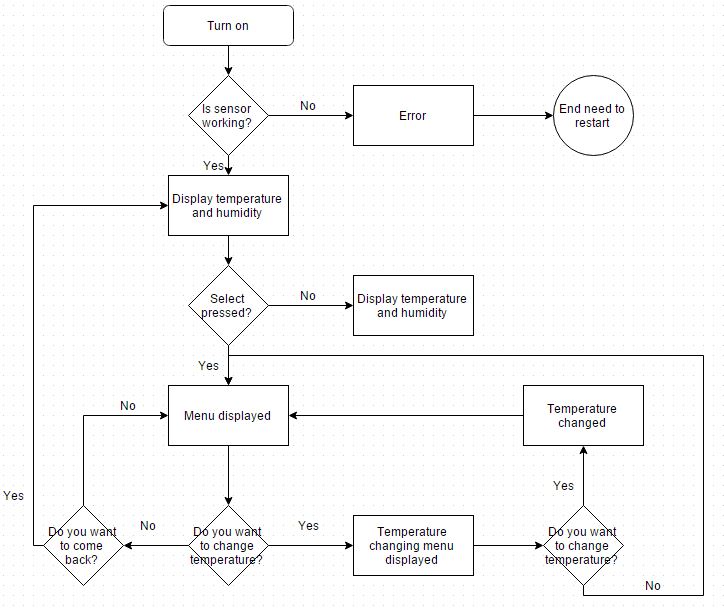
Figure 7.31: Flow chart of our software
Easily disposable
The system has a sophisticated manual disposable system which allows the user to easily dispose the insect defecation by having a layer of nets,plastic and a drawer to pull out the insect dung and at the same time keep the insects in the same position by having a net.
7.5 Tests and Results
Maintaining temperature
As we want to have inside the insectarium a temperature between 25℃ and 30℃ we made some calculations and in accordance to results it is enough to turn on heater for 67.41 to keep proper temperature. By keeping proper temperature we do not mean warming up. It means that if temeprature fell belowe minimum temperature it will take 67.41 seconds to come back to desired minimum temeprature.
Q=Cv*∆T=0.0647 kJ/℃*(30-25)℃=0.32355kJ
Cv=c*m=1.007 kJ/(kg*℃)*0.06426kg=0.0647 kJ/℃
m_air=D*V=1.19kg/m^3 *(0.6*0.3*0.15) m^3=0.06426 kg
P=Q/t
t=Q/P=323.55J/4.8W=67.41 s
RESULT: 67.41 seconds
Warming up
We are using heater from toaster and supplying it by 12 volts. Warming up is a slow process and can warm insectarium up to 29-31 degrees. We are happy with this results because we did not want to make it very fast because it can bad affected on insects. In accordance to our test insectarium need specified time to warm up. In a table below we can see how much it takes to warm up by one degree on few specified degrees and the chart we can see how long it take - 227 minutes.
Table 7.10: Table of temperature variety
| Temperature[°C] | Time [min] |
|---|---|
| 24 | 8 |
| 25 | 9 |
| 26 | 10 |
| 27 | 15 |
| 28 | 24 |
| 29 | 40 |
| 30 | 54 |
| 31 | 63 |
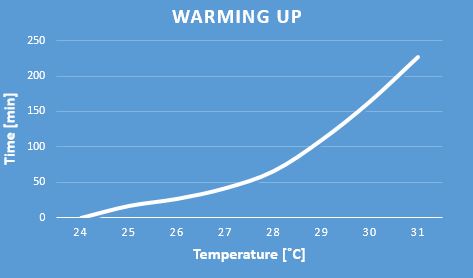 Figure 7.32: Temperature in time chart
Max Temperature
The maximum temperature that we obtained with our heater inside insectarium was equal to 31.1 degree and we hardly believe that it is maximum temperature because we turned the heater on for 5 hours and for last two hours temperature did not change. During further tests we obtained the maximum temperature equal to 29.4 and 29.1 degrees. The changes in maximum range are probably connected with temperature of outside air. It is important to notice that when we obtained the highest temperature air temperature was equal to 27 degrees and other days around 22 degrees.
Cooling up
To cool our insectarium we are using fan. Unfortunately it is is not as efficient as we predicted and the lowest temperature that we can obtain usually is half degree lower that air temperature. For example during tests air temperature was equal 27 degrees and we obtained 26.4 degrees by using fan. Lowering the temperature from 31 degrees to 27 degrees took 50 minutes.
Electronic devices and coding
Test of electronic devices was totally successful. During testing we had no problems with any device. DHT22, Fan, LCD, Heater, Arduino all of them were working properly. It also means that the code was written correctly and logically and works in accordance to flowchart. However, wires connections are not strong because we cannot solder anything and we also used bread board instead of for example circuit board but as long as it is prototype it is not a problem.
Power Consumption
It is very important to assume power consumption of our product. Usually only adruino,lcd and sensor will be working but in the worst case also heater and fan but not both at the same time. That is why we calculated is as follows.
Heater:
Voltage: 12 V
Current:0,4 A
Watts: 4.8 W
Table 7.11: Power consumption of heater
| Power consumption per hour | 0.0048 kWh |
|---|---|
| Power consumption per month | 3.456 kWh |
| Power consumption per year | 42.048 kWh |
Fan:
Voltage – 12V
Current – 0.14 A
Watts - 1.68 W
Table 7.12: Power consumption of fan
| Power consumption per hour | 0.00168 kWh |
|---|---|
| Power consumption per month | 1.2096 kWh |
| Power consumption per year | 14.7168 kWh |
Arduino:
Voltage – 12 V
Current – 0.8 A
Watts - 1.68 W
Table 7.13: Power consumption of Arduino
| Power consumption per hour | 0.0096 kWh |
|---|---|
| Power consumption per month | 6.912 kWh |
| Power consumption per year | 84.096 kWh |
LCD:
Voltage – 5 V
Current – 0.05 A
Watts - 0.25 W
Table 7.14: Power consumption of LCD
| Power consumption per hour | 0.00025 kWh |
|---|---|
| Power consumption per month | 0.18 kWh |
| Power consumption per year | 2.19 kWh |
Sensor:
Voltage – 5 V
Current – 0,0025 A
Watts - 0.0125 W
Table 7.15: Power consumption of sensor
| Power consumption per hour | 0.0000125 kWh |
|---|---|
| Power consumption per month | 0.009 kWh |
| Power consumption per year | 0.1095 kWh |
Now we will consider all possibilities:
Arduino + LCD + Sensor
Table 7.16: Power consumption of Arduino + LCD + Sensor
| Power consumption per hour | 0.0000125 + 0.00025 + 0.0096 | 0.00986 kWh |
|---|---|---|
| Power consumption per month | 0.009 + 0.18 + 6.912 | 7.101 kWh |
| Power consumption per year | 0.1095 + 2.19 + 84.096 | 86.39 kWh |
Arduino + LCD + Sensor + Fan
Table 7.17: Power consumption of Arduino + LCD + Sensor + Fan
| Power consumption per hour | 0.0000125 + 0.00025 + 0.0096 + 0.00168 | 0.01154 kWh |
|---|---|---|
| Power consumption per month | 0.009 + 0.18 + 6.912 + 1.2096 | 8.3106 kWh |
| Power consumption per year | 0.1095 + 2.19 + 84.096 + 14.7168 | 101.1068 kWh |
Arduino + LCD + Sensor + Heater
Table 7.18: Power consumption of Arduino + LCD + Sensor + Heater
| Power consumption per hour | 0.0000125 + 0.00025 + 0.0096 + 0.0048 | 0.01466 kWh |
|---|---|---|
| Power consumption per month | 0.009 + 0.18 + 6.912 + 3.456 | 10.557 kWh |
| Power consumption per year | 0.1095 + 2.19 + 84.096 + 42.048 | 128.438 kWh |
Thanks to the calculations we can observe that the best case is when only Arduino + LCD + Sensor Is turn on and the worst case when Arduino + LCD + Sensor + Heater are turned on.
Table 7.19: Power consumption per hour
| Best case per hour | 0.00986 kWh |
|---|---|
| Average case per hour | 0.01226 kWh |
| Worst case per hour | 0.01466 kWh |
Table 7.20: Power consumption per month and year
| Average case per month | 8.829 kWh |
|---|---|
| Average case per year | 107.414 kWh |
We have checked the prices of electricity in Portugal and assuming that we have to pay 0,2641 € per kWh we know that:
The average cost of one hour will be 0.0026 €.
The average cost of one month (working 24h/day) will be 2.33 €.
The average cost of one year (working 24h/day) will be 28.37 €.
7.6 Final pictures


Figures 7.33-7.39: Depict our final product.
7.7 Conclusion
Overall the results show the temperature must be between 25 and 30 degrees ,if the temperature is out of range the heater needs to be on for 67 seconds to allow the insectarium to be a stable temperature ( under 25 degrees ).
Most important test were successfully. Building is ready for insects, Arduino is programmed correctly, sensor works correctly. Heater is warming up slowly and maximum temperature is around 29-30 degrees but in our opinion it is efficient enough. However, not every tests were successfully, fan is not efficient enough to cool down lower than outside temperature but on the other hand it accelerates the cooling process. The other problem that we face during test is the smell of the glue and plastic, when inside insectarium temperature is higher than 30 degrees it is possible to notice a bad smell. Notwithstanding, we are happy with our results.
7.8 Movie concept
1. Who are we as a team ?
- present every member of the team - present their skills - present their part of the project
2. What is Insecto ?
- which problem do we adres with our product - how can our product be used - why should it be used - who is our target group
3. Process of the project from beginning till end
- wiki - thinking - Designing/printing of leaflet - designing of construction - meetings - electronic schematics - designing/printing of poster - actual building of insecto - testing
4. present the final product to sell
concept/idea of presenting team
- idea 1 : i’m planning to use the photos from the first presentation to present every team member and the the team as a group. i can add comments in after effects of their skills and who they are. like a sort of slide show.
Maby half of the screen i can use as a movie of that person working on the project just to make it more dynamic
- idea 2 : Film every member when he is working. use this movies in after effects and add their skills and general information
- idea 3 : use only animations ( difficult but easier to apply te same style on every part in the movie )
2. concept/idea of explaining insecto
- idea 1 : animated infographic of numbers and facts about insecto and the problem we’re adressing
—> see stopmotion from last year
- idea 2 : voice over of someone who is telling about the facts and number while their is a video playing of us working on the project idea 3 : use only animations ( difficult but easier to apply te same style on every part in the movie )
3. concept/idea of project process
- idea 1 : filming screens and everybody working on the project with a good song in the background and a title of the part where their working on.
- idea 2 : with voice over ?
- idea 3 : use only animations ( difficult but easier to apply te same style on every part in the movie )
4. concept/idea of presenting/selling insecto
- -idea 1 : pictures and actual film material of the insectarium while explaining and selling the product.
- -idea 2 : 3D pictures/movie of 3D insecto spinning with animations to present it in the nicest way as possible idea 3 : use only animations ( difficult but easier to apply te same style on every part in the movie )
movie sketch Storyboard
presenting team


Figure 7.40 - 7.46: Presenting team
work progress

Figure 7.47 - 7.49: Work progress
explaining insecto

Figure 7.50 - 7.52:Explaining insecto
selling and presenting the insectarium

Figure 7.53 - 7.55: Selling and presenting the insectarium
7.8 Conclusions
We try to follow one concept. We start as a team, each of us has special skills that we can share the work and come further a bit faster. We have the aim to occur as a serious and intelligent team which build good devices. We are motivated from the beginning till the end. While building, while presenting and while selling the Insectarium. And that could be our advantage to become successful in the market.
8. Conclusions
Final Conclusion
Overall as a group we learned to work in a strict time scale communicate and present ourselves well despite the language barrier problems and successfully build our project within the limited budget of 100 euros (spending 70 euros ) despite having problems with choice of materials and schematic designs we managed to do this in the short time scale necessary, the advisers had some complainants with some parts of the wiki but we felt as a group we couldn't overcome these problems until we built the system (e.g functional tests ).
Our project was built smoothly with it being made very similar to the design we made with the computer programme solid works which shows we managed to design and build our project successfully with an effective electronic temperature control system which is capable of growing many different insects and helping feed the growing hunger of the worlds human population.
The insectarium is elegant with its bright blue and green colours for the market as demanded from the project specification demands.
The insectarium is easy to use with its flexible LCD backshield with keyboard to allow the user to select the temperature and humidity to select the correct environment for the chosen insect which allows it to be very flexible in the market to feed humans and insects worldwide as requested.
It has a sophisticated manual disposable system of defecation which consists of layers of nets and wood which allows the user to keep the enclosure clean effectively which meets certain health regulations demanded.
We believe the project was a fun and exhilarating challenge which we benefited from greatly as an experience for our careers by living in a different country and working with people from all over Europe.
Thank you for the great experience and opportunity .
8.1 Discussion
In the extra technique class we discussed about features or improvements of the product and the trappings. We made a brainstroming and sort the ideas in two different sections. In the following are the ideas of visual and user friendly improvements:
Visual Improvements:
- optical illusions for design

 - sticker for the background e.g. nature
- exchangeable designs, looks and colors
- round corners in the building
- logo on the insectarium
- how to make the packaging
- add landscape into the insectarium
User Friendly Improvements

 - child friendly - make it fun for kids
- make the advantages clear for the customers
- mobile app to control the temperature and humidity while holiday
- online instruction in different languages
- automatic ejection
- food/ water dispenser
- touch screen control
- provide tweezers
- easy transportation
- handle to pick it up
- attach wheels
- possibility to attach to wall
Some of them are very similar and that makes it easier to see which is most important to install in the future or as a feature and how the customers maybe think. We perform the most important points in the following.
Figure 7.48 - 7.51: Shows the teamwork by making a brainstorming about the products development
8.2 Future Development
The recommendation for the products future and the distribution for the customers are three important points: We want to offer our product as simple as possible for the customers. We decide to make more or less of the design changeable, that the customers can adjust it to the flat for instance. Design such as the background, the living room the colors of the plastics. Another feature we think about is to make the Insectarium mobile as possible. For instance by attaching wheel and handles to carry it and give the possibility to attach it on the wall, so the customers can place their Insectarium where they want to. The last improvements are small extras which are orderable individually such as fixed tweezers, water/ food dispenser or special sensors.
Which is most important when electrical devices are installed is the alarm buzzer or better the emergency stop. We plan the install it for the first production because of the safety.
All special thoughts we have should be realized in the future. Not like a standard but as features these are orderable individually to make the product more innovative and special for each and every customer
Bibliography
The End of Solution SalesCustomers don't need salespeople – so sales leaders need a new playbook. Download the ArticleFeatured in Harvard Business Review Score Your Pre-Sales ActivitiesIn creating customer demand. (n.d.). Retrieved March 16, 2015, from http://www.executiveboard.com/exbd/sales-service/the-end-of-solution-sales/index.page
Recyclable Planet. (n.d.). Retrieved March 16, 2015, from http://www.recyclableplanet.com/smanufacturing.php
Communications Management. (n.d.). Retrieved February 23, 2015, from http://www.tutorialspoint.com/management_concepts/communications_management.htm
Darkling Beetle/Mealworm Information. (n.d.). Retrieved February 24, 2015, from http://insected.arizona.edu/mealinfo.htm
Scope (project management). (n.d.). Retrieved March 4, 2015, from http://en.wikipedia.org/wiki/Scope_(project_management)
Componentes para robótica e electrónica - PTRobotics. (n.d.). Retrieved March 24, 2015, from http://www.ptrobotics.com
Code of Ethics. (n.d.). Retrieved March 18, 2015, from http://www.nspe.org/resources/ethics/code-ethics
(n.d.). Retrieved March 22, 2015, from http://deres.org.uy/wp-content/uploads/Manual-de-Etica-DERES.pdf
Engineering Creeds, Oaths, and Pledges. (n.d.). Retrieved March 24, 2015, from http://www.onlineethics.org/Resources/ethcodes/Pledges.aspx
Ethical Practices in Sales & Marketing. (n.d.). Retrieved March 24, 2015, from http://smallbusiness.chron.com/ethical-practices-sales-marketing-64319.html
Sales & Marketing Creed: The International Code of Ethics for Sales and Marketing. (n.d.). Retrieved February 21, 2015, from https://www.smei.org/?16
(n.d.). Retrieved February 28, 2015, from http://study.com/academy/lesson/environmental-ethics-human-values-definition-impact-on-environmental-problems.html
(n.d). Retrieved February 24, 2015, from http://mealwormcare.org/breeding/
(n.d). Retrieved March 23, 2015 from http://lexicon.ft.com/Term?term=risk-management
(n.d). Retrieved March 23, 2015 from http://www.gdrc.org/uem/lca/lca-define.html
What is marketing environment? How many types of marketing environment? Explain the influence of micro and macro environment on marketing. (n.d.). Retrieved April 7, 2015, from http://www.josbd.com/Market_Environment.html
Insekten als Nahrungsmittel – unsere Zukunft? (n.d.). Retrieved April 8, 2015, from http://youarehungry.com/insekten-als-nahrungsmittel-unsere-zukunft/
(n.d.). Retrieved April 8, 2015, from http://kaufmann-werden.de/sites/default/files/dokumente/Situationsanalyse, Marktanalyse.pdf Heizungen. (n.d.). Retrieved April 8, 2015, from https://www.meintierdiscount.de/heizungen/produkte/6483-0-0-6483-0.htm?cat=620&tier=reptil
Analyse der Makroumwelt anhand von sechs relevanten Komponenten. (n.d.). Retrieved April 8, 2015, from http://derwirtschaftsinformatiker.de/2012/11/15/corporate-management/analyse-der-makroumwelt-anhand-von-sechs-relevanten-komponenten/
Forschung aktuell / Beitrag vom 19.05.2014. (n.d.). Retrieved April 8, 2015, from http://www.deutschlandfunk.de/landwirtschaft-insekten-als-viehfutter.676.de.html?dram:article_id=285844
UN werben für mehr Insekten auf dem Speiseplan. (n.d.). Retrieved April 8, 2015, from http://www.welt.de/gesundheit/article116143425/UN-werben-fuer-mehr-Insekten-auf-dem-Speiseplan.html
Entomophagie beim Menschen. (n.d.). Retrieved April 8, 2015, from http://de.wikipedia.org/wiki/Entomophagie_beim_Menschen
Insektarium. (n.d.). Retrieved April 8, 2015, from http://de.wikipedia.org/wiki/Insektarium
Ãber uns. (n.d.). Retrieved April 8, 2015, from http://www.fressnapf.com/de-de/überuns/international.aspx
Tierbedarf, Tierfutter, Tiernahrung günstig kaufen bei zooplus. (n.d.). Retrieved April 8, 2015, from http://www.zooplus.de/content/aboutus_general
ABOUT US. (n.d.). Retrieved April 8, 2015, from https://www.zoetis.co.uk/about-us.aspx
Jardim Zoológico de Lisboa - Homepage. (n.d.). Retrieved April 8, 2015, from http://www.zoo.pt/site/index_en.php
Fast zwei Millionen Bio-Bauern weltweit. (n.d.). Retrieved April 8, 2015, from http://bio-markt.info/berichte/Fast_zwei_Millionen_Bio-Bauern_weltweit.html
(n.d.). Retrieved April 8, 2015, from http://www.forfarmers.de/
(n.d.). Retrieved April 8, 2015, from http://kaufmann-werden.de/sites/default/files/dokumente/Situationsanalyse, Marktanalyse.pdf
Demographics of Portugal. (n.d.). Retrieved April 13, 2015, from http://en.wikipedia.org/wiki/Demographics_of_Portugal
Demographics of Europe. (n.d.). Retrieved April 13, 2015, from http://en.wikipedia.org/wiki/Demographics_of_Europe
Product Liability and Ethics. (n.d.). Retrieved April 9, 2015, from http://www.scu.edu/ethics/publications/iie/v4n1/pay.html
Frenz, R. (2010, December 31). Ethics & Liability. Retrieved April 9, 2015, from http://www.ehow.com/info_7758260_ethics-liability.html
Print Banners24. (n.d.). Retrieved April 21, 2015, from http://www.printbanner24.de/calculator.php
Weebly is the easiest way to create a website, store or blog. (n.d.). Retrieved April 21, 2015, from http://www.weebly.com/free-trial/index.php?c=mkt_w_nwk:Affiliate_cat:NaturaInt_type:top10_camp:NI-INTL_ag:2-3_subid:V13-20249001Pb&lang=de
(n.d.). Retrieved April 21, 2015, from https://www.ratioform.de/webshop/business.exe/pw=sm/vs=de/key=0d1de5eb738f9b20b671a5f9ccf78b7326d800d301O03/center/search/main.ipm?search=quick&init=0&ff_filter_group_world_key=280132&ff_filter_group_category_key=280632&button_generic=search&url_stack_id_
I. Gegenstand, Bedeutung und System der Marketing-Planung und -Kontrolle. (n.d.). Retrieved April 24, 2015, from http://www.daswirtschaftslexikon.com/d/marketing_planung_und_kontrolle/marketing_planung_und_kontrolle.htm
Skript/Handbook TVVS, Germany university